Gold had a stunning start to 2012, gaining more than USD 200 per ounce in a little under two months. But, there are plenty of people out there wary of gold, writes Kathleen Brooks, director of research at Forex.com.
Gold has had a stunning start to 2012. After reaching a low of $1,550 per ounce at the end of December it is currently hovering just below $1,800 after gaining more than $200 per ounce in a little under two months. But, there are plenty of people out there wary of gold because of its performance in 2011.
Last year was definitely a year of two halves for the yellow metal. Firstly it appreciated nearly 40%, which led some to conclude that this was a super-cycle for gold and $2,000, even $5,000, per ounce was not beyond the realm of possibility. Talk about speaking too soon, after trying to touch $1,900 in September and failing it went on to decline another 18% by year-end, eroding profits and leaving some investors stung. 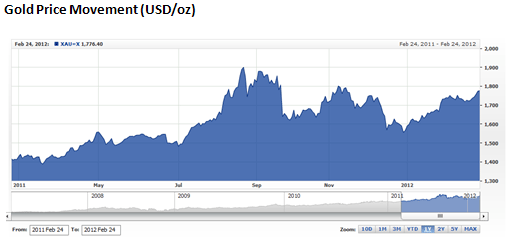
Source: Zawya
So after the good start to 2012 it's worth trying to understand the dynamics of the gold price and why it performed so badly in the second half of 2011 when the Eurozone debt crisis was at its peak.
Trying to work out the balance of factors that weigh on the oil price helps to understand why people buy gold in the first place. Gold is used as an inflation hedge, a safe haven, for jewellery and it has industrial uses. The main types of buyers include investors, private individuals and businesses. Thus, gold is bought for diverse reasons by a bunch of diverse people and companies. This is important as it can help explain what happened in 2011, which may shed light on gold's performance this year.
The World Gold Council's 2011 market overview makes an interesting observation about gold's (lack of) performance last year. It argues that you can't just expect a safe haven asset (like gold), or an asset that traditionally has a low-correlation to other asset classes, to never sell-off at the same time as equities, commodities etc. This is because gold can be the victim of its own success. For example, some of the reason for the selling pressure in the second half of 2011 was actually down to investors having to sell their most profitable assets (read gold) to pay for margin calls elsewhere.
However the World Gold Council points out that the gold price was protected because of the diverse base of gold buyers. So while the investment community sold gold, central banks boosted their holdings by 439.7 tonnes last year, the highest figure since 1964. Private investors also steadily increased their purchases of gold in 2011. But this argument only goes so far, yes, gold held up well versus European equities which had hefty declines last year, however, it actually fell more than US stock markets like the Dow Jones Industrial Average which fell 16% over the same period.
Some argue that it was almost like a perfect storm for the gold price last year. Not only did investor demand dip but demand from India also swooned. This is of major concern for the gold price since India is the world's largest gold market. The gold price tends to do well during the Indian Diwali festival that takes place each October, which traditionally sees a large up-tick in jewellery demand for the yellow metal as it is given as presents to mark the festival of light. However, last year demand for gold from India around Diwali collapsed by 40% relative to 2010. In total India bought 564 tonnes of gold last year, 14% below 2010 levels.
There are a couple of reasons for this: typically Indian demand for gold is lower during periods of volatility, thus people may have not wanted to buy gold last year in case the price kept falling. (Gold may be used for jewellery but it is very much an investment in India). Currency effects may have also played their part. Gold is priced in US dollars and the rupee plunged more than 20% against the dollar during last year's risk sell-off, making gold more expensive.
So we understand why gold underperformed in the latter months of 2011, but what about 2012? There may be some good news for the gold bugs: firstly, investors continue to remain concerned about the Eurozone and a break-up of the euro, which should attract demand for the yellow metal. Likewise, we have seen a global round of central bank easing and QE, which may stoke inflationary fears at some stage. When this happens the investment community tends to dive into gold, which partly explains the yellow metal's strong start to the year.
Also, signs of stabilisation in the Eurozone post the ECB liquidity injection in December may halt any "fire sales" of gold by investors trying to convert profitable assets to cash like we saw in the second half of last year.
But one reason that is rarely discussed about why the price may remain well supported this year is a development that will fundamentally impact the Indian market. At the end of last year the Cabinet in Delhi approved a bill that will make the hallmarking of gold compulsory. This is a major development since gold quality has historically been patchy across India. Now that there is a "gold standard" it may entice reluctant buyers who want to be sure they are getting the real McCoy when it comes to spending thousands of dollars on the precious metal.
One thing is for sure, 2012 is likely to be just as interesting for gold this year. Will it finally take its place as the world's safe haven and break away from other "risky" assets like stocks? Will India and its new hallmark law be the saviour of the gold price? This is one diverse market and many factors could impact its direction, but right now we are off to a good start with $1,800 per ounce in view.
Disclaimer: The information and opinions in this report are for general information use only and are not intended as an offer or solicitation with respect to the purchase or sale of any currency or CFD contract. All opinions and information contained in this report are subject to change without notice. This report has been prepared without regard to the specific investment objectives, financial situation and needs of any particular recipient. Any references to historical price movements or levels is informational based on our analysis and we do not represent or warranty that any such movements or levels are likely to reoccur in the future. While the information contained herein was obtained from sources believed to be reliable, author does not guarantee its accuracy or completeness, nor does author assume any liability for any direct, indirect or consequential loss that may result from the reliance by any person upon any such information or opinions.
Foreign Exchange and other leveraged products involves significant risk of loss and is not suitable for all investors. Increasing leverage increases risk. Spot Gold and Silver contracts are not subject to regulation under the U.S. Commodity Exchange Act. Contracts for Difference (CFDs) are not available for US residents. Before deciding to trade forex, you should carefully consider your financial objectives, level of experience and risk appetite. Any opinions, news, research, analyses, prices or other information contained herein is intended as general information about the subject matter covered and is provided with the understanding that FOREX.com is not rendering investment, legal, or tax advice. You should consult with appropriate counsel or other advisors on all investment, legal, or tax matters. FOREX.com is regulated by the Commodity Futures Trading Commission (CFTC) in the US, by the Financial Services Authority (FSA) in the UK, the Australian Securities and Investment Commission (ASIC) in Australia, and the Financial Services Agency (FSA) in Japan.
© Forex.com 2012