Dubai emerges as the region's hot spot in an EIU survey on the world's most competitive cities. But, overall, the region's metropolises' fared poorly in the list.
Has Dubai got its mojo back? A new survey ranks the emirate as the region's top 'hot spot', leaving behind other regional luminaries.
Lately, Doha appears to have been edging out Dubai, and closing the gap with the emirate in global surveys (see links below), but the Citibank-sponsored Hot Spots: Benchmarking Global City Competitiveness, shows the emirate in good form and at the top of the heap.
Also Read: McKinsey's Future Cities
Centres of Attention
Dubai has had a good year to date, with the Dubai Financial Market already up 23% in the year, and real estate prices have clawed their way back up 2-3% during the fourth quarter last year.
With the emirate working its way through its debt pile and tourism and retail sector picking up, there is certainly a spring in Dubai's step.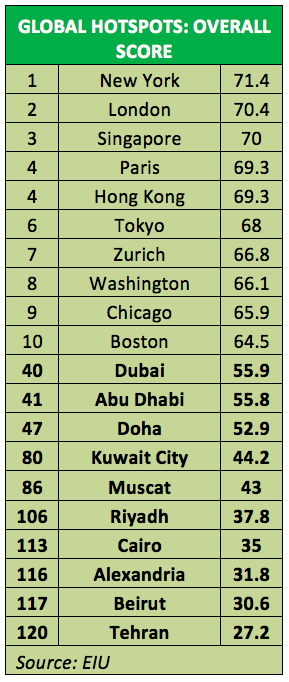
LONG WAY DOWN
Still, there is no reason for complacency. Overall, Dubai was 40th in the list, below places like Birmingham and Auckland.The EIU developed the "Global City Competitiveness Index" and measured cities across eight categories and 31 indicators. Categories include economic strength, human capital, institutional effectiveness, financial maturity, global appeal, physical capital, social and cultural character and environment and natural hazards. A city's overall ranking in the benchmark Index is a weighted score of the underlying categories.
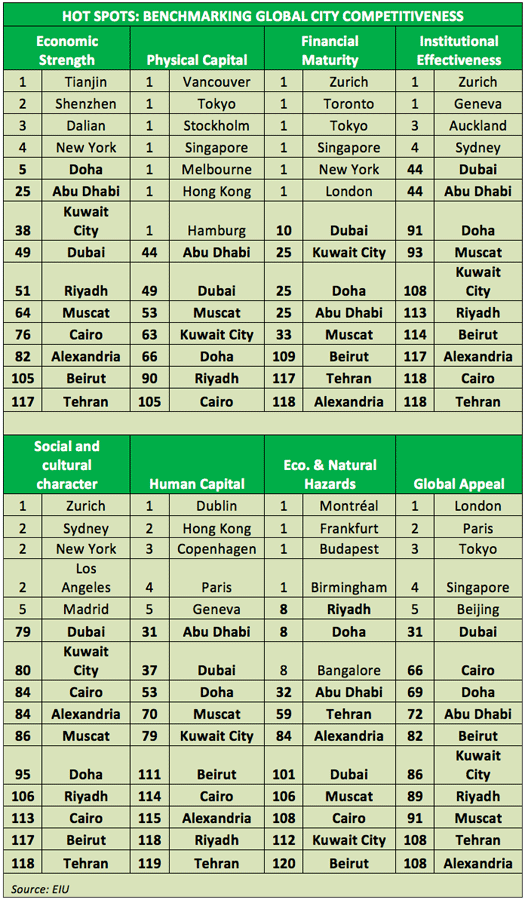
Among the eight categories, Doha earned the highest rank, at 5th for 'economic strength', Dubai was 10th in 'financial maturity', 31st in 'global appeal', 44th in 'institutional effectiveness', and 77th in social and cultural character. Meanwhile, Abu Dhabi ranked 31st in 'human capital', 44th in 'physical capital' and Riyadh was 8th in 'environment and natural hazards'.
The EIU highlights Dubai as an example of cities focusing on key areas.
"Dubai, Santiago and Singapore are just three examples of cities with specific programmes in place to attract talent from elsewhere," notes the EIU. "Dubai is rapidly building a business friendly, zero tax environment to attract workers; Santiago is helping host a national initiative to directly incentivise hundreds of entrepreneurs from around the world to move there; and Singapore is bolstering its reputation as the gateway to Asia's growth, with a first-rate living environment to support it."
Doha also impressed with its fifth place in economic strength, as it leverages its gas riches to build an economy that's well diversified and has punched above its weight by winning the right to host the 2022 FIFA World Cup.
But overwhelmingly, many of the cities Middle East cities found themselves at the bottom end of the list.
Cairo, Beirut, Tehran and Alexandria languished right at the bottom in most categories suggesting the negative perception of global investors with these cities.
GLOBAL CITIES
The 120 surveyed in the report are true economic powerhouses."With a combined population of about 750m, they generated some US$20.2trn dollars in GDP in 2008 (measured in purchasing power parity), or about 29% of the global total," notes the EIU.
"This gives them a larger contribution to the global economy than the European Union (US$15.5trn), United States (US$14.3trn) or China (US$8.3trn), according to the Economist Intelligence Unit (EIU)."
The EIU expects these cities to collectively grow by around 4.8% on average till 2016, with many Asian and Chinese cities clocking double-digit growth.
New York emerged as the world's most competitive business hub with London emerging as second. Asian hotspot Singapore narrowly edged out Hong Kong and Paris for third spot.
Tokyo was 7th in a list dominated by western nations.
Indeed, Beijing could muster a lowly 39th place and Shanghai was 43rd, behind Dubai and Abu Dhabi in the overall ranking.
"Economic dynamism is definitely rising elsewhere, especially in Asian cities, but U.S. and European cities have legacy advantages that give them a strong competitive edge," said Leo Abruzzese, the EIU's global forecasting director. "In particular, these developed cities are better at attracting top talent from across the world."
EMERGING MARKETS
While European nations dominate for now, the future belongs to emerging markets.
"The rise of emerging markets will likely make a number of largely unknown cities rather more prominent by 2020. Bandung, Hangzhou, Lagos and Lima, for example, all feature growth rates of 6% or higher, but are familiar to few outside of their home countries today. That will change."
Another key growth area is the rise of mid-sized cities with populations of 2 million to five million such as Abu Dhabi, Lima, Bandung, Dalian, Hangzhou, Hanoi, Pune, Qingdao, and Surabaya.
"In fact, just nine of the 23 megacities (with populations over 10 million) ranked in the top 30 on economic strength. These mid-size cities are collectively forecast to grow by 8.7% annually over the next five years, ahead of the megacities on which many firms focus," notes the report.
Given the importance of vibrant cities to a country's well being, Middle East governments will do well to turn their large metropolis as liveable, business-friendly and accessible locations.
At the moment most Middle East cities fall woefully short, as the survey suggests. It would be worthwhile for governments to invest in places like Cairo, Beirut, Alexandria, Kuwait City and Riyadh and turn them into engines of growth.
© alifarabia.com 2012