09 September 2012
Looks like the Middle East may not get much in terms of economic relief from global markets.
The outlook for the global economy looks muggy right up till 2016, according to SocieteGenerale, in a special report on global economic outlook.
The Middle East and other emerging markets are confronted with the grim reality that demand from the advanced economies is going to be structurally lower.
SocGen's grim outlook is focused on five key themes that it believes will dictate markets over the next four years:
(1) The muddle-through policy approach will continue over the 2013horizon, only gradually giving way to a shift to confidence;
(2) the European Central Bank will not deliver any blank cheques and conditionality will remain firmly in place entailing continued recession in the euro area periphery;
(3) Two-thirds of the U.S. fiscal cliff will expire, exerting a drag of 1.4pp on the U.S. economy in 2013;
(4) China will avoid a full-blown hard-landing but the shift to a new growth model will see a structurally weaker growth outlook; and
(5) Second round effects from oil and food prices will be minimal, in turn allowing central banks around the world to maintain exceptionally accommodative policy stances.
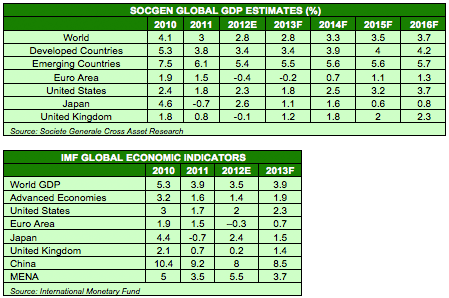
The global economy will grow between 3% to 3.7% each year till 2016, with developed economies posting growth of between 2% to 2.6% during the period. That means much of the heavy lifting will be done by emerging markets that are set to grow between 5.5 to 5.7% during the same period, according to SocGen estimates.
The Eurozone, Japan and United Kingdom will be the real laggards, although the United States will start posting above 3% growth from 2015 onwards.
SocGen's central argument is that the developed economies still haven't deleveraged enough. It has historically taken global economies to get out of recession over five years, but this time is different - it will take a lot longer!
"The global scope of today's crisis, weak demographics, structural rigidities in a number of advanced economies, the institutional crisis in the euro area and a tighter regulatory backdrop all point to a slow recovery. Our view is that,
this time, it will take a decade."
It is only after 'muddling' through the lost decade, will the economies slowly gain confidence around the latter half of the decade.
For oil-exporting Middle East economies, there is unlikely to be a boost from oil price spikes, as demand is expected to remain relatively subdued.
"Indeed, OPEC has already started to trim crude supply," notes Michel Martinex, analyst at SocGen. The lack of global catalysts mean, regional economies will have to find other ways to boost economy. They may have to take lessons from Asian economies which face a similar crisis.
"Each country has to look within its domestic borders to discover new growth drivers."
An IMF Spillover Report which identifies the impact of a prolonged Euro crisis on the global economies, believes most Middle East market will see deleveraging of at least a percentage in response to a sovereign shock in the EU. Egypt is even more vulnerable to an exit of a European country or default could lead to a 1% to 5% deleveraging in the economy.
Meanwhile, Saudi Arabia may be especially vulnerable to a U.S. 'fiscal cliff' crisis.
EASTERN GROWTH FADES PUTTING PRESSURE ON MIDEAST
Oil exporting countries like Saudi Arabia and the UAE which have increased looked at Asian markets for growth may also feel the pressure as growth in the east starts to fade.
China has helped to make up some of the shortage in demand from advanced economies since 2008, especially benefitting producers of capital goods and commodities.
Once again major oil exporters like Saudi Arabia could see a 0.35% decline in growth if Chinese investments into the economy start stalling
"Simple regressions suggest that a 1 percentage point cut in Chinese investment growth (which has averaged 14%) has large growth effects on Asian supply chain countries and less-diversified commodity exporters," noted the IMF.
The Middle East economies can't operate in vacuum. While they have boosted their economies with domestic stimulus, they ultimately need emerging advanced economies to feed off.
"The world economy remains one of interdependence, where countries'
business cycles travel across borders," says Kemal Dervi? is Vice
President and Director of Global Economy and Development at the
Brookings Institution. While emerging and developing economies are growing
much faster than advanced economies, cyclical movements around trends,
linked more to shorter-term demand-side factors, are likely to be
strongly correlated.
"The recent global growth declines in early 2012, due much more to macroeconomic and financial sector management issues than to long-term supply-side factors, vividly reflect this worldwide interdependence."
And let's not forget the Gulf sovereign wealth funds that remain heavily exposed to financial markets of advanced economies and companies, primarily in Europe and the United States.
It is clear, that Gulf economies are unlikely to breakout and post exponential growth unless the advanced economies start posting a smart recovery.
Looks like the Middle East may not get much in terms of economic relief from global markets.
The outlook for the global economy looks muggy right up till 2016, according to SocieteGenerale, in a special report on global economic outlook.
The Middle East and other emerging markets are confronted with the grim reality that demand from the advanced economies is going to be structurally lower.
SocGen's grim outlook is focused on five key themes that it believes will dictate markets over the next four years:
(1) The muddle-through policy approach will continue over the 2013horizon, only gradually giving way to a shift to confidence;
(2) the European Central Bank will not deliver any blank cheques and conditionality will remain firmly in place entailing continued recession in the euro area periphery;
(3) Two-thirds of the U.S. fiscal cliff will expire, exerting a drag of 1.4pp on the U.S. economy in 2013;
(4) China will avoid a full-blown hard-landing but the shift to a new growth model will see a structurally weaker growth outlook; and
(5) Second round effects from oil and food prices will be minimal, in turn allowing central banks around the world to maintain exceptionally accommodative policy stances.
The global economy will grow between 3% to 3.7% each year till 2016, with developed economies posting growth of between 2% to 2.6% during the period. That means much of the heavy lifting will be done by emerging markets that are set to grow between 5.5 to 5.7% during the same period, according to SocGen estimates.
The Eurozone, Japan and United Kingdom will be the real laggards, although the United States will start posting above 3% growth from 2015 onwards.
SocGen's central argument is that the developed economies still haven't deleveraged enough. It has historically taken global economies to get out of recession over five years, but this time is different - it will take a lot longer!
"The global scope of today's crisis, weak demographics, structural rigidities in a number of advanced economies, the institutional crisis in the euro area and a tighter regulatory backdrop all point to a slow recovery. Our view is that,
this time, it will take a decade."
It is only after 'muddling' through the lost decade, will the economies slowly gain confidence around the latter half of the decade.
For oil-exporting Middle East economies, there is unlikely to be a boost from oil price spikes, as demand is expected to remain relatively subdued.
"Indeed, OPEC has already started to trim crude supply," notes Michel Martinex, analyst at SocGen. The lack of global catalysts mean, regional economies will have to find other ways to boost economy. They may have to take lessons from Asian economies which face a similar crisis.
"Each country has to look within its domestic borders to discover new growth drivers."
An IMF Spillover Report which identifies the impact of a prolonged Euro crisis on the global economies, believes most Middle East market will see deleveraging of at least a percentage in response to a sovereign shock in the EU. Egypt is even more vulnerable to an exit of a European country or default could lead to a 1% to 5% deleveraging in the economy.
Meanwhile, Saudi Arabia may be especially vulnerable to a U.S. 'fiscal cliff' crisis.
EASTERN GROWTH FADES PUTTING PRESSURE ON MIDEAST
Oil exporting countries like Saudi Arabia and the UAE which have increased looked at Asian markets for growth may also feel the pressure as growth in the east starts to fade.
China has helped to make up some of the shortage in demand from advanced economies since 2008, especially benefitting producers of capital goods and commodities.
Once again major oil exporters like Saudi Arabia could see a 0.35% decline in growth if Chinese investments into the economy start stalling
"Simple regressions suggest that a 1 percentage point cut in Chinese investment growth (which has averaged 14%) has large growth effects on Asian supply chain countries and less-diversified commodity exporters," noted the IMF.
The Middle East economies can't operate in vacuum. While they have boosted their economies with domestic stimulus, they ultimately need emerging advanced economies to feed off.
"The world economy remains one of interdependence, where countries'
business cycles travel across borders," says Kemal Dervi? is Vice
President and Director of Global Economy and Development at the
Brookings Institution. While emerging and developing economies are growing
much faster than advanced economies, cyclical movements around trends,
linked more to shorter-term demand-side factors, are likely to be
strongly correlated.
"The recent global growth declines in early 2012, due much more to macroeconomic and financial sector management issues than to long-term supply-side factors, vividly reflect this worldwide interdependence."
And let's not forget the Gulf sovereign wealth funds that remain heavily exposed to financial markets of advanced economies and companies, primarily in Europe and the United States.
It is clear, that Gulf economies are unlikely to breakout and post exponential growth unless the advanced economies start posting a smart recovery.
alifarabia.com 2012