Did the U.S. Federal Reserve Chairman Ben Bernanke give Gulf markets yet another boost by signalling his intention to launch QE3 if needed?
"Over the past five years, the Federal Reserve has acted to support economic growth and foster job creation, and it is important to achieve further progress, particularly in the labor market," noted the U.S. Federal Reserve Chairman at his annual speech at the Jackson Hole in Wyoming, the venue of his first stimulus announcement in 2009.
"Taking due account of the uncertainties and limits of its policy tools, the Federal Reserve will provide additional policy accommodation as needed to promote a stronger economic recovery and sustained improvement in labour market conditions in a context of price stability," he noted.
While Mr. Bernanke didn't explicitly announce his intention to launch the third tranche of quantitative easing, he did highlight that past QE efforts by the Federal Reserve worked well for the U.S. economy and it remains a key policy option for the bank as it warily eyes lethargic job creation and economic growth.
"[The] speech made clear Bernanke's view that non-traditional policy moves such as asset purchases have been successful in lowering interest rates and thus boosting economic growth," said Paul Ferley, assistant chief economist at RBC Capital. "Though there are potential costs to using these tools, the speech makes clear that in Bernanke's view such are manageable."
Mr. Bernanke's signal should help buoy Gulf markets, which have enjoyed a nice rally over the summer.
Dubai has led the way, rising 14.37% year-to-date (August 31), with Saudi Arabia - the region's largest market, also rising 11% this year. Abu Dhabi has also been firmly in the black, rising 6.58% year-to-date. Other regional markets have stumbled: Qatar (-3.30%), Bahrain (-5.02%) and Oman (-3.78%) markets remain firmly in the red, while Kuwait is marginally up 0.83% year-to-date.
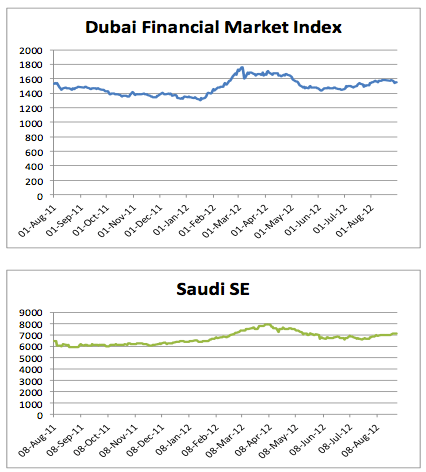
Much of the regional momentum has been despite global economic turmoil. European economies - the Gulf's largest trading partner - have not inspired confidence in global markets, while even emerging economies of India and China have tottered.
Over the past four months, oil prices had slipped back from their year highs on weakening global demand but have remain at comfortable levels purely on the back of geopolitical tensions.
EFG-Hermes believes QE3 would help Gulf markets.
"We see the GCC region being an overall beneficiary of a possible third round of Quantitative Easing (QE)," noted Monica Malik, analyst at EFG. "The growing expectations of stimulus moves from the US and other central banks have already provided support to the oil price, despite weak demand fundamentals."
EFG expects a more modest rise in the oil price if QE3 is announced than was the case in previous rounds, with much of the upside already priced in.
"As such, we maintain our 2012 average oil price forecast of USD114.0 p/b for Brent crude (oil has averaged USD112.3 per barrel year-to-date), although note substantial downside risks. The oil price continues to be positive for sentiment in the GCC, supporting expansionary government spending that is driving non-oil activity. We expect non-oil activity to increase across the region from September after the quieter summer and Ramadan period."
Meanwhile, Europe is also looking at European Stability Mechanism (ESM) bonds, designed to provide members with financial assistance.
All eyes will also be on Mario Draghi, the European Central Bank chief, who is expected to speak on September 6 and offer greater insight into the ECB's plan of action, which could further boost markets.
"Expectations of central bank intervention have drawn attention away from China, but we think the outlook for Chinese demand will remain important for MENA markets for the next year," notes Fahd Iqbal, EFG analyst. "Uncertainty over Chinese and EM demand may explain the weak performance of MENA materials stocks over the past month in spite of the rise in oil prices - we continue to favour exposure to banks over materials in MENA. Lastly, U.S. elections and the 'fiscal cliff' are also major sources of risk for markets that are currently being played down."
However, markets may be setting themselves up for disappointment.
It may be politically tricky for the U.S. Federal Reserve to launch QE3 this close to a U.S. elections. This is especially true as Republican Presidential candidate Mitt Romney does not believe the Fed should launch in QE3 and any stimulus move by the Fed may be seen by the Republicans as giving a boost to U.S. President Barack Obama so close to the elections.
The ECB has also disappointed markets before and even though Mr. Draghi famously said a few weeks ago that the ECB will do 'all it takes' to get the Euro house in order, he has not matched those words with deeds - yet.
A lack of inaction from central banks could lead to a strong market reversal, especially if it weakens oil prices further - and that could easily derail regional and global markets.
© alifarabia.com 2012