Gulf markets are set to rise 10% to 15% this year on the back of strong economic fundamental and the return of risk appetite, according to Bahrain-based Securities & Investment Company (SICO).
"We recommend more focus on large cap stocks, as most had a subdued performance in 2012. Accordingly, large cap stocks such as Etisalat, SABIC, First Gulf Bank, Samba, Almarai, Aldar and Emaar to outperform small cap stocks in 2013," said SICO in a report.
"Improvement in corporate earnings post-2009 is not fully reflected in market prices leading to attractive valuations. S&P GCC currently trades at a price-to-earning ratio and price to book ratio of 11.25x and 1.53x respectively."
After spending years in the wilderness, bulls have been riding the regional rally hard as if making up for lost time.
The Dubai stock market rallied 15.5% in January alone.
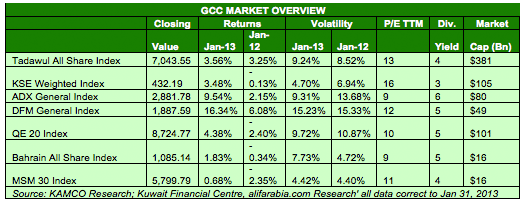
"Investors were quite optimistic on the back of a strong rebound in the real estate sector in the country and in anticipation of healthy Q4 corporate earnings. The tourism sector also gave the required thrust with Dubai International airport becoming the world's third busiest airport, displacing Hong Kong," wrote Markaz analyst M.R. Raghu in a report. "Abu Dhabi gained 8.4% in Jan-2013, the biggest monthly gain since October 2007."
A strong rebound in real estate, pick-up in tourism and hotel industry and investors bullish bet on the Q4 corporate earnings have all contributed favourably to the surge in GCC markets at the start of 2013, the analyst noted.
Combined, the Gulf seven major markets added USD29.7-billion to their market capital in January lone to reach USD792.5-billion. The Saudi Tadawul index increased market cap by USD10.7-billion during the month.
The UAE market fared even better, rising USD11.2-billion with both Abu Dhabi Dubai reaching heights last scaled years ago.
"Investors' risk appetite in the GCC replenished on hopes that a recovery in economies that have been experiencing a slowdown after the global financial crisis may show signs of improvement in the near future," said KAMCO Research in a report. "All combined, this pushed GCC equity markets to record highs in what seems to be a strong and positive beginning for 2013."
But can the rally continue?
Most analysts believe markets have lagged the Gulf states' economic stimulus programmes.
Saudi Arabia is in the midst of one of its most expansionary fiscal policy, pouring billions of dollars in real estate, infrastructure, healthcare, manufacturing and financial services.
Fitch Ratings expects the Kingdom's economy to hum along even if oil prices remain "conservative".
"Government spending has been the main impetus behind the strength of the private sector (construction was the fastest growing sector in 2012) and with policy remaining expansionary in 2013, further healthy private sector growth is anticipated," said Paul Gamble, director of sovereigns at Fitch. "Bank lending and strong consumer and corporate confidence should also support the private sector."
Qatar already boasts one of the most fundamentally-sound economies and the government is keen to invest in its non-oil infrastructure in the build up to the 2022 FIFA World Cup.
Meanwhile, National Bank of Kuwait has revised its real non-oil GDP in 2013 from 4% to 5% on the back of greater determination by the authorities to implement the four-year development plan.
"These include projects in the transport, power and oil refining sectors," said NBK in its country report. "This should ease the economy's dependence on growth in the consumer sector, which will nevertheless remain firm thanks to high employment levels and fresh government measures to support income growth."
The confidence is reflected in the strong 8% gain on the Kuwait Stock Exchange Index year-to-date.
The Bahraini economy also received a boost in January when Standard & Poor's Ratings Service raised the country's outlook from negative to stable.
"Our ratings on Bahrain are supported by the country's strong external and fiscal positions, both of which are underpinned by hydrocarbon resources," said S&P in a January note. "The ratings are constrained by our view of continuing domestic political tensions and the fiscal dependency on sustained high oil prices and international donor support. The ratings are also constrained by stagnating real GDP per capita growth, which we forecast at about 1% in 2013-2015."
Further down south, Oman is also expected to post a robust 4.1% growth in 2013, fuelled by high oil prices and public spending, which will stimulate the non-oil economy and positively affect the banking sector over the 12-18 month
outlook period.
"Oman's stable macroeconomic conditions will create lending opportunities for banks and support credit growth of around 10%-12% in nominal terms in 2013," said Moody's.
The Muscat Securities Market is up 3.8% as investors look at the bright side.
Finally, the UAE markets have roared as Dubai and Abu Dhabi both unveil a raft of projects and rake in investments.
The UAE Prime Minister and Ruler of Dubai Sheikh Mohammad Bin Rashid Al Maktoum recently announced that the emirate had attracted USD8-billion in foreign investments since the Arab Spring crisis.
A return of business confidence has encouraged Dubai a fresh slew of projects as hospitality, tourism and retail sectors rebound.
"Regional project pipeline remains string (USD 2,046-billion) and grew 9% year-on-year, implying a backlog equivalent to twice compared to GCC's total current GDP," said SICO.
"Government's fiscal balances may deteriorate led by public sector wage hikes, but consumer-driven sectors should continue to benefit from increased spending. Continued steady improvement in profitability and attractive valuations should keep investors interested."
© alifarabia.com 2013