Barclays Capital expects GCC economies to rise 5.4% this year, but Citibank worries that a sudden drop in oil prices could leave the states with a dilemma: whether to curtail spending or keep pumping funds into the economy.
Barclays Capital has revised its growth forecast upwards for Gulf states to 5.4% from 4.1% for 2012 on the back of high oil revenues, even though it expects business confidence and sentiment to remain subdued to regional tensions.
Barclays also expects total government expenditure to rise by a further 3% in 2012, after clocking an astonishing 22% increase last year. Still, oil prices and higher production would ensure that the fiscally the Gulf GDP's remain collectively in positive territory at 11.6% of GDP in 2012.
The GCC's oil and gas industry stands to benefit the most from sanctions on Iran but it could also suffer the most if the Strait of Hormuz is closed, BarCap notes.
The Gulf's combined production stood at 16.7 million bpd in January with spare capacity of 3.3 million bpd - which is enough to offset Iran's 2.3 million of exports - at least technically.
The rising exports will result in greater oil income and boost growth by a full 1.3 percentage points.
However, an attack by Israel on Iran may force the closure of Strait of Hormuz, which could take away 6.65 million bpd of Gulf oil exports that pass through the strait.
HORMUZ ALTERNATIVES
However, Gulf producers are working on alternative plans, with Abu Dhabi set to be best placed to take advantage once the Habshan-Fujairah pipeline is fully operational later this year.
In January, the UAE's energy minister said that the pipeline, designed to transport 1.5 million barrels per day, should hopefully be operational within six months.
"As we have previously said, a prolonged closure of the Strait is a low probability," said Mark Brown at Fitch Ratings, the ratings agency. "As well as the practical challenge of physically blocking it, we think Iran would only choose to close an international shipping lane that is the world's most important oil chokepoint as a last resort, given the potential for international retaliation. Iran also exports oil via the Strait."
Fitch notes that if the Strait was blocked in the second half of this year, when the Habshan-Fujairah pipeline could be operational, it would potentially provide Abu Dhabi the best safety net.
It would enable Abu Dhabi, which has the world's second largest per capita reserves of hydrocarbons, to continue to export up to around two-thirds of its oil output, or around three-quarters of its current net oil exports, by bypassing the Strait and delivering oil to the Gulf of Oman.
Currently Saudi Arabia holds the advantage as it already enjoys pipeline access to the Red Sea via the East-West pipeline. The country could export more than half its output through this pipeline, which has a maximum capacity of five million barrels per day and currently transports around 1.8 million barrels per day.
"However, even at maximum capacity, with 2011 output running at 9.3mbd and no decline so far this year due to the tensions over Iran, a higher proportion of Saudi oil output and exports would be stuck inside the country if they could not be shipped out of the Persian Gulf," said Fitch's Brown.
Meanwhile, all oil exported from Kuwait and Qatar is transported through the Strait of Hormuz. Last month, Standard & Poor's said Qatar is most vulnerable to the closure of the strait.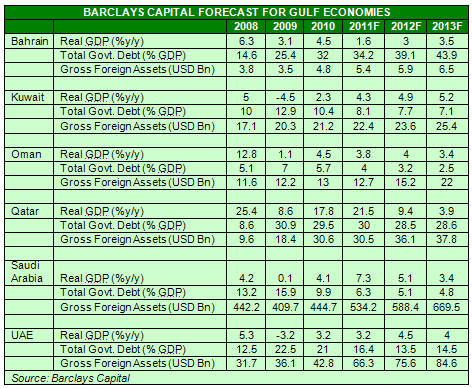
CITI'S DIFFERENT SCENARIO
While BarCap is upbeat about Gulf prospects, Citibank looks at the glass as half empty.
The bank is worried that oil prices, which have run up on speculation that Israel will attack Iran, may ease due to a slight softening of political stance from both Tehran and Washington.
Since tensions last year, there have been some signs of reconciliation or at least a pullback from talk of war.
Israeli Prime Minister Benjamin Nethanyahu was unsuccessful in convincing U.S. President Barack Obama to give his blessing for an Israeli attack on Iran.
The U.S. President has also aimed to soothe tensions by calling calls of war as 'bluster' and said there was a 'window of opportunity' for diplomatic talks. The sentiment was praised by the Islamic regime's Supreme Leader Ayatullah Khaminieh, showing greater Iranian inclination to get back on the negotiating table.
Iran and the IAEA have also agreed to discuss the issue further and while a resolution seems a thousand miles away, it relieves some of the tense atmosphere that has been building up in the region over the past few months.
The European Union has also said that global powers will resume talks with Iran about its atomic plans.
Indeed, a survey of 28 oil analysts show that at least half of them expect oil prices to decline as early as this week on easing tensions.
OIL PRICE DROP?
Looking ahead, Citibank contemplates that a sudden drop in oil prices could upset the Gulf states' plans.
Budgetary breakeven oil prices are continuing to nudge upwards, with estimated weighted average GCC oil breakeven price is US$85 per barrel, according to Taib Bank.
A decline in crude prices could leave the GCC states with a dilemma: whether to continue to pursue economic growth or avoid potentially large fiscal imbalances from emerging.
Citibank believes the Gulf states are keen on pursuing high economic growth. This is especially true for Bahrain, Oman and Saudi Arabia, which have seen some sort of unrest in the country. Another key area of concern is that participation rates in the labour force are particularly low in these countries, even by regional standards.
To avoid protestors on the street, these three Gulf states will need to keep expenditure high to ensure job creation.
"It is also worth noting that the aforementioned countries have the lowest relatively low levels of wealth per capita, combined with a significant young population put a premium on economic growth in Saudi Arabia, Bahrain and Oman," wrote the bank according to a report.
"At the level of fiscal loosening, Saudi Arabia, along with Kuwait, Qatar and Abu Dhabi have the resources to maintain government expenditures at a high level even if a sharp fall in oil prices reduced revenues and led to fiscal deficits.
If oil prices were to fall to USD60 per barrel, public finances will be most vulnerable in Saudi Arabia and Kuwait, notes Citibank.
However, Saudi Arabia at least can absorb a fiscal shock. Jadwa Investment notes that the Kingdom's domestic debt will fall to SR 100 billion by 2013, the lowest in nine years, and a massive improvement over the SR475 billion of domestic debt in 2005.
Meanwhile, Saudi official foreign assets are expected to rise to USD738.5 billion in 2013, compared to USD195.5 billion in 2005.
KUWAIT'S WORRIES
Kuwait is no laggard either. While Kuwait oil exports may moderate to accommodate for Libyan oil flows, it still is expected to generate nearly 5% growth in GDP.
"The current and fiscal surpluses for 2012 are projected at 30.3% and 19.3% of GDP, respectively, which can potentially be diverted to Kuwait's sovereign wealth fund," notes Taib Bank.
Kuwait's biggest worry remains its own political deadlock, rather than external factors.
"Lingering strains in the financial sector coupled with failure to fully deliver on capital spending due to political tensions, is expected to be a major road block for growth in the non‐oil sector," notes Taib Bank.
ABU DHABI, QATAR SAFE, BAHRAIN, OMAN NOT SO
Abu Dhabi and Qatar, which have amassed significant resources, have little to fear.
Barclays Capital expects Qatar to post a 9.4% growth in GDP, while the UAE is expected to generate a respectable 4.5% improvement in economic growth.
By contrast, Bahrain and Oman do not have the reserves to finance the deficit, and would need either to rein in expenditures or seek alternative funding.
Oman has projected a fiscal deficit for 2012 but if oil prices remain firm at current levels, sizeable current and fiscal surpluses are on the cards, says Taib Bank.
Moreover, considering Oman is not an OPEC member, it will retain flexibility to take unilateral advantage of oil price fluctuations.
High oil export concentration to Asia (80%) should provide a buffer in case of slower developed world demand.
Bahrain, meanwhile, will continue to lag its Gulf counterparts, especially as the recent show of strength by protestors suggests that the Kingdom's troubles are far from over.
The country already has the highest breakeven oil price - over USD 100 per barrel - and is the smallest oil producer among Gulf states.
"Bahrain may need to rely on external flows to balance its fiscal deficit which is projected at 9.9% of GDP (relatively weak credit ratings are a risk as evidenced by the highest CDS spreads in the region)," notes Taib Bank. "Similar to Oman, GCC countries have announced a US$10bn package for housing infrastructure development in Bahrain."
Meanwhile, the picture looks far rosier for the UAE. Abu Dhabi is buildings on its rock solid finances by streamlining investments and taking a more measured approach to spending policy.
Dubai, much weaker financially, is showing signs of a turnaround with the real estate finally appearing to bottom out. Dubai Inc. is also working out its debt issues, boosting investor confidence.
"We see upside based on only moderate public debt/GDP ratios and Abu Dhabi's support of Dubai Inc," notes Exotix analyst Stuart Culverhouse. "The yield pick-up outweighs concerns over GREs and the 2014 funding."
CONCLUSION
It should not be a surprise that the Gulf economies are vulnerable to oil prices and a sudden drop would effect them negatively. But, with the exception of Bahrain and to certain extent Oman, they are fiscally well placed to take a hit.
The real dilemma for them - as Citibank pointed out - is whether to curb spending or keep massaging the economy.
And the answer this time may well be that the Gulf economies do not have a choice: they will have to keep investing to ensure that the Arab Spring - that has seen the downfall of at least four rulers, with a fifth on the way - is kept firmly at bay.
© alifarabia.com 2012