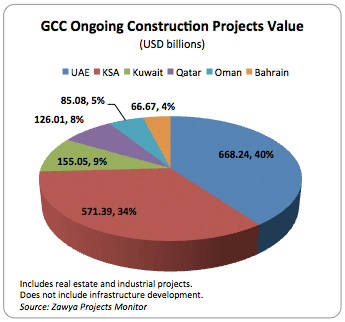
Based on ongoing construction status, the Gulf interior design, contracting and fit-out industry is estimated at more than USD 50 billion, of which the UAE alone accounts for USD 15 billion. However, no surprise, Saudi Arabia and Qatar are the fastest-growing Gulf markets for the interior design and fit-out industry. "Saudi is the biggest market right now in terms of scale. With a rapid population growth rate, it has a huge demand for residential units. It also has a major focus on education and health," Nemr Sidani, managing partner at In Design, an interior design consultancy, told Zawya. "Qatar is preparing for the World Cup, which has led to the design and planning of many sports/events-related developments as well as hospitality projects to meet projected demand."
The industry has its challenges, said Sidani. "With project delays, postponements and can-cellations, financial survival is currently the biggest challenge currently faced by the industry. Other issues include retaining good talent and being able to keep pace with business in the new emerging markets." Bodies like APID and IIDA have helped to keep the regional interior design industry together and reinforce standards, he added.
In terms of the types of projects that present the maximum opportunities, Sidani sees potential within the tourism sector in UAE. "With its ideal position as a tourist attraction, the country has many hospitality projects in the pipeline, along with new developments planned in the education and health sector like Saudi Arabia."
Long-Term Outlook Strong
Although the UAE market has started improving in 2012, it has not yet matched business expectations, said Faten Alsarraf, managing director at Final Fix. "At the moment, Iraq is a new potential market where we have experienced a huge demand for interior design and fit-out work within hotels, malls and residential complexes. Saudi Arabia too has a lot of potential for interior fit-out work if you just look at all the hotels being built in Mecca and Medina to accommodate the millions of pilgrims every year."
The interior design, contracting and fit-out accounts for around 35% to 40% of a project's contract value, according to interior design heads. Interestingly, while data is available on the value of projects, the current market is rife with developments being re-designed and undergoing value-engineering due to financial constraints.
The market is also seeing a drop in the prices of building materials as well as lackluster demand for completed projects with demand not matching supply.
But the long-term outlook for the region's fit-out sector is good. "GCC's favorable demographics will support growth in coming decades, though the youth bulge, combined with potentially weaker political institutions, could provide an important challenge for policy-makers given structural labor market rigidities. Unlike aging economies where stagnant labor force growth implies a greater need for productivity growth to sustain GDP growth, the GCC is likely to exhibit strong labor force growth over the period to 2050," said a recent Bank of America Merrill Lynch report.
It added: "The GCC medium-term plans share the recognition of the centrality of institution building and human development to the growth model. Among key pillars targeted are the increase in the participation of nationals in the labor force, the establishment of advanced educational and health systems, attracting foreign capital and increasing competiveness, and diversification through expansion and design of industries with competitive advantages derived from hydrocarbon industries (in some cases, through an integrated system of economic cities and business clusters). To the extent a critical mass is achieved, the latter strategy would also provide for room for growth in ancillary sectors and services to service the newly setup industries, in our view."
With no pressing need to alter growth engines, more endowed countries (Saudi Arabia, Qatar and UAE) have better chances to outperform, added BoAML. "Over time, however, differentiation could emerge as the growth model transitions and favors open and diversified stories (UAE), with an easier prospect of change, over domestic and investment ones. We believe Dubai, in particular, will prove a long-term winner, driven by continued population growth and benefiting from its past superior infrastructure investment.
"Though the short-term outlook seems dull and accurate data was not always available for all building types in terms of current interior space and gross leasable area, we see robust potential for the medium to long-term haul where the GCC interior design, contracting and fit-out industry can tap into the potential of future units, office stock, hotel rooms and retail outlets within the region, which will always need its services."
The Shift to Green
Another area of opportunity will lie in the shift towards green, which will need new expertise and associated products as clients and consultants start looking at the necessity to become environmentally responsible. Not just because it is mandatory in Abu Dhabi's new projects thanks to Estidama, or that Qatar has implemented a new green code, but that smart green projects offer a higher return on investment for the developer in the long run along with energy savings for the end-user.
"With the world going green, some of the latest interior trends will include smart and interactive kitchens and bathrooms. Kitchen equipment can be set, controlled and shut off through the internet," said Sidani. "With bathrooms, controlling water consumption has become a huge priority and it has also become necessary to save and re-use water as greywater.
"When it comes to other surface finishes, I have noticed that most flooring companies are developing at least one product within their range which is green. This is already part of specifications in the US. While it is still not the biggest priority in the region, the municipalities in Abu Dhabi and Dubai have a special department dedicated to developing this area," Sidani said.
Alsarraf notes two new trends. "Nowadays, clients have started to appreciate kitchens and bathrooms and don't mind paying extra to get better finishes and spaces in these two areas. Another new trend is a preference to have an open kitchen in the living areas, a concept that was not given much consideration by clients in the GCC in the past," she said.
According to Alpen Capital research, the Gulf construction market did show signs of stability in the second half of 2011. "Moreover, the real estate market of UAE, particularly Dubai, was affected positively by the recent Arab Spring in some parts of the Middle East, reinforcing the UAE's reputation of being a safe and stable country... In the longer term, we maintain an optimistic view of the residential construction market of the UAE on the back of rising population and stable economic growth," Alpen Capital said.
Further afield, Saudi Arabia has announced a renewed drive to increase employment of Saudi nationals in construction projects. The kingdom is building four new economic cities: King Abdullah Economic City, Prince AbdulAziz bin Mousaed Economic City, Knowledge Economic City, and Jazan Economic City. In these developments, around five million residents are expected to live, work and play. With a total investment of around USD 69 billion, these four economic cities are expected to add around 428 million square meters of space to the residential, commercial, hotel, port, and industrial sectors.
Kuwait still has a housing shortage while Saudi Arabia will also address its housing issues with numerous projects for national housing. Oman and Qatar will continue to focus on tourism and sport, respectively. The interior design, contracting and fit-out business will remain busy for a long time to come.
© Zawya 2012