Nigeria, South Africa, Angola, and Ethiopia are among the African countries that offer the biggest opportunities for foreign investors, according to Ernst & Young report.
"We are excited and very positive about Africa," said Ajen Sita, CEO of Ernst & Young Africa, in a report Africa By Numbers.
"We are optimists, but we are realistic optimists - our perspective is deliberately a glass half full rather than half empty one. This is mainly because we believe that it takes a positive mindset to succeed in Africa. If you set out expecting difficulty and risk, you will find it. However, ours is not a point of view informed by anecdotes and wishful thinking - the numbers speak for themselves."
UNCTAD notes foreign direct investment in Africa fell to USD4.7 billion in 2012, primarily because of the problems afflicting North African states, especially Egypt, Libya and Tunisia which saw the full impact of Arab Spring and witnessed massive upheavals and regime change.
Meanwhile, sub-Saharan Africa saw a jump in foreign direct investment, recovering from USD29 billion in 2010 to USD37 billion in 2011, a level comparable with the peak in 2008, said UNCTAD, adding that prospects in the continent are "brightening."
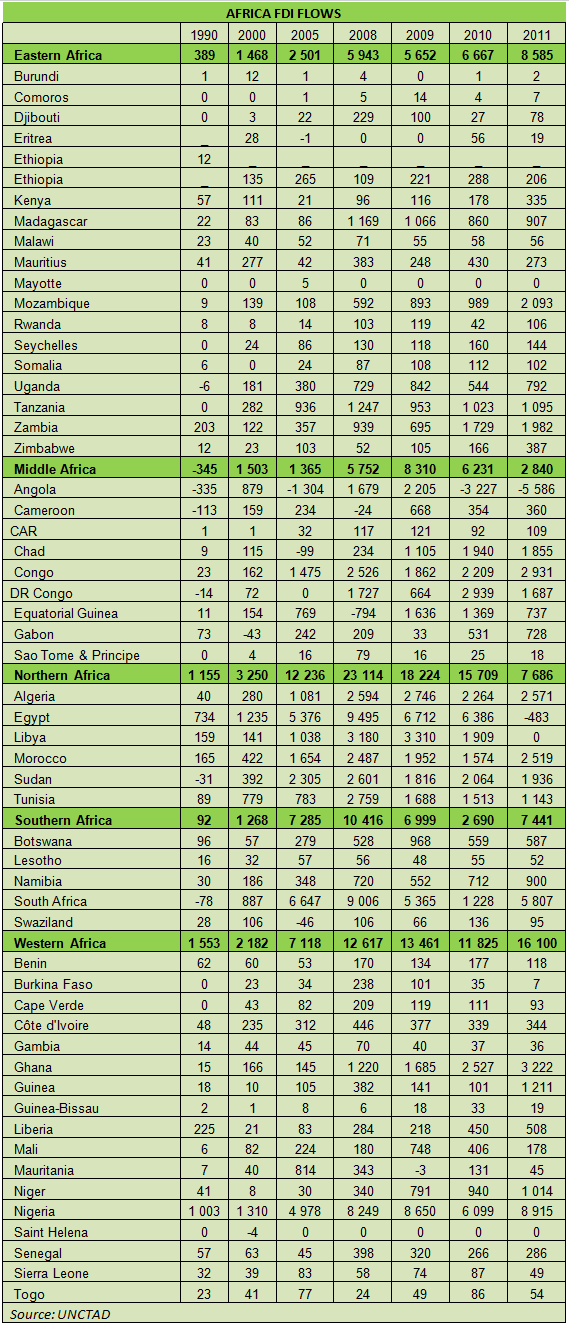
"A rebound of FDI to South Africa accentuated the recovery. The continuing rise in commodity prices and a relatively positive economic outlook for sub-Saharan Africa are among the factors contributing to the turnaround. In addition to traditional patterns of FDI to the extractive industries, the emergence of a middle class is fostering the growth of FDI in services such as banking, retail and telecommunications, as witnessed by an increase in the share of services FDI in 2011."
Western and developed countries saw their FDI flows to Africa, leaving emerging markets to pick up the slack.
And they have not been shy. China has led the emerging market drive into Africa, pouring billions in places like Angola, Sudan, among other places, to secure energy supplies for the future.
"The growing economic importance of China is most visible in the trade data, which show that in 2011 China had become the largest single country trade partner with SSA," notes Citibank in a report.
"In fact, trade between SSA and China over the 2002-11 decade has grown by 38% a year, compared to 13.7% a year for EU trade and 17.5% for U.S. trade."
The Asian giant has also pledged up to USD20-billion in credit to Africa to build infrastructure and agriculture over the next three years.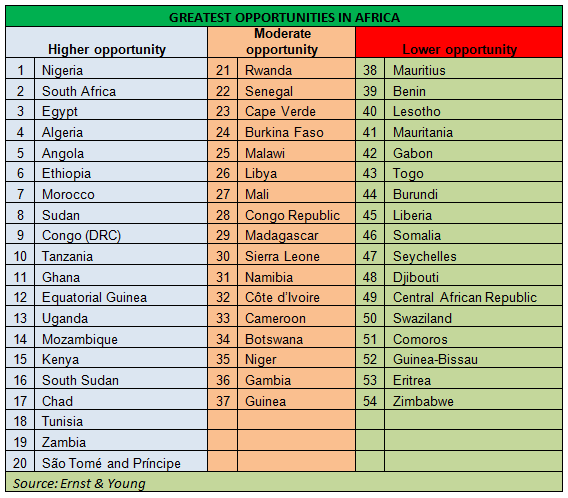
NIGERIA LEADS THE WAY
E&Y believes Nigeria has all the pre-requisites to emerge as the most attractive African country to foreign investors.
"Nigeria heads up the opportunity index ranking. With the largest population in Africa (at over 160m it also has the seventh-largest population in the world), a sizable economy, and sustained high single digit growth rates, it is an exciting RGM by any standards," said E&Y in its report.
Meanwhile, Ethiopia and Mozambique have consistently been among the fastest growing economies in the world for over a decade, while countries such as Angola and the Democratic Republic of Congo benefit from extremely rich resource bases, notes E&Y.
"It is worth noting that the three largest members of the East African Community (EAC), Kenya, Uganda and Tanzania, are all in this top list - within the next five years the population and economic output of the EAC is forecast to exceed that of both Bangladesh and Vietnam's today."
At the other end of the spectrum, Zimbabwe is viewed as the least attractive African nation, partially because of its dictatorial regime that has sucked the life out of the economy.
Eriteria was the second least attractive nation for foreign investors, and is considered one of the poorest and repressive regimes in the world.
The country was recently accused by the Human Rights Watch for using forced labour at a mining site operated by a Canadian company.
"If mining companies are going to work in Eritrea, they need to make absolutely sure that their operations don't rely on forced labor," said Chris Albin-Lackey, business and human rights senior researcher at Human Rights Watch. "If they can't prevent this, they shouldn't move forward at all."
Nevsun, the Canadian company, said the subcontractor which was alleged to have used forced labour was state-controlled and the company was "required to use" the company for construction work at the project.
The event shows how foreign investors can entangled in African countries with poor regulatory framework and lack of transparency, which could sully the reputation of international companies.
5 RECOMMENDATIONS FOR INVESTORS
E&Y says while Africa offers great opportunities, they will have to pick their bets and plot their strategy carefully to play a winning hand in Africa.
Here are its five top recommendations:
1 Africa: half full or half empty: When you think of Africa do you think of corruption, poverty, turmoil and war?
"This cannot be the frame of reference, otherwise it will infect every decision that has to be made. There has to be a strong belief in the African growth story; that Africa is good for business and investment; and that business and investment is good for Africa."
2 Build your investment portfolio: Diversifying your African investment profile is crucial to spread the political risk, think of whether you can have an early mover advantage, and whether the population metrics merit the investments.
3 Human resource investment: The best laid plans can come to nought if you do not have the human workforce to execute it.
"Securing a supply of the best local people, recruiting in the diaspora, transferring skills from other parts of your company and working hard to retain key staff will be an essential element of success."
4 Expand from strategic economic hubs: Foreign investors in Dubai will be familiar with this mode. Use a regional and developed hub to operate in other markets.
"Expansion plans should also look at non-conventional regional market groupings such as urban corridors, cultural affinities and regional economic communities in order to build critical mass and drive higher returns more quickly."
5 Go beyond the bottomline: Companies will do well to look beyond economic and job creation and contribute to the socio-economic development.
"Expansion plans should also look at non-conventional regional market groupings such as urban corridors, cultural affinities and regional economic communities in order to build critical mass and drive higher returns more quickly."
© alifarabia.com 2013