With politics dictating Egypt's economy, analysts expect the banking sector to recover only by next year. Also, can Egyptian banks survive a devaluation of the pound?
Is it too early to make 2013 predictions?
With Egypt's economy in doldrums thanks to intense political turmoil, the country's banking sector has been hit by lack of public and private sector growth.
So much so that some analysts believe that the rest of 2012 will be pretty much frittered away due to the grand tussle between the Muslim Brotherhood and the Supreme Council of Armed Forces (SCAF). Instead market observers have set their sights on a recovery next year.
"We believe this trend is likely to continue through 2H12 and early 2013, until a clearer political and economic situation arises," says May El Haggar, analyst at Cairo-based Naeem Research and co-author of a report on the Egyptian banking sector. "We expect loan growth through 2012 to still depend largely on corporate demand for short-term credit facilities, with demand on longer-term facilities picking up in 2013."
In the absence of an economic recovery, Treasury Bills have been the main driver of growth since mid-2011, after the government resorted to funding the budget deficit through domestic borrowing, says El Haggar.
Egyptian banks woes have not been lost on ratings agencies who have taken note.
Moody's Investor Service believes Egypt's operating environment will remain challenging over the next 12-18 months, underpinned by weak economic growth prospects and a negative investment climate.
In view of government financing needs stemming from its large budget deficit (equivalent to 10% of GDP in fiscal year 2012), Moody's expects the banks to further increase their already significant sovereign exposures.
"During 2011, Egyptian banks' government debt holdings increased to 550% of equity, from 430% in December 2010, linking banks' credit profiles directly to the credit risk of the sovereign," said the agency, adding that capital levels are weak and that reported capital ratios overstate the extent of banks' current buffers, as high exposures to government securities are zero-risk-weighted.
Moody's also expects that the banks' asset-quality metrics will deteriorate over the outlook period, with the ratio of non-performing loans (NPLs) to gross loans reaching 15%-18% by the end of 2013.
In addition, the country's banking sector faces increasing liquidity challenges, suggested by a fall in the banking system's core liquid assets to 17% of total assets at December 2011, from 23% a year earlier.
In June Standard & Poor's placed three Egyptian banks on negative watch. National Bank of Egypt (NBE), Banque Misr (BM) and Commercial International Bank Egypt (CIBE) were placed on negative watch as a direct result of Egypt's sovereign downgrade.
All three banks are highly exposed to government debt, although S&P does not believe the Egyptian government will default on its obligations.
The agency considers NBE and BM to be government-related entities with their fortunes are linked directly to the government.
"S&P would downgrade the banks if escalating political tensions and the authorities' ongoing ineffectiveness in addressing economic, fiscal, and external challenges further weaken key economic and external indicators while also undermining donors' and multilateral lending institutions' willingness to extend support," the agency said.
NBE is Egypt's largest bank by assets, with a dominant domestic franchise, especially in customer deposits, where it accounts for over a quarter of total system deposits. While observers believe that the authorities would support the bank, it does present risks.
The banking sector's troubles come at a time when the global financial services sector is also in a tailspin. European banks, who are looking to deleverage due to the monumental problems in their own backyards, don't have the luxury to ride out Egypt's trouble.
France's biggest bank BNP Paribas is reportedly looking to sell its 70-branch network in the North African country as part of its global massive cost-cutting exercise and to meet tougher capital requirements in the EU.
Piraeus Bank was also reportedly looking to offload its 41-branch Egyptian operations to generate USD200-million, but has now inexplicably called it off.
Meanwhile, the Egyptian Financial Services Authority's decision to question Qinvest's 60% stake in EFG-Hermes, adds an element of uncertainty in an already tough economic environment.
However, HSBC Middle East's 5% stake in EFG earlier this month in the midst of the uncertainty brings home the point of Egyptian financial services long-term prospects.
Despite the odds and the tough economic environment, the banking sector has tried to puts it best foot forward.
Sector loans grew 1.3% quarter-on-quarter (5.5% year-on-year) in the first quarter to EGP495.9bn, mainly due to a 1.6% increase in corporate loans, primarily focused on short-term credit facilities.
"We expect 2012 sector loan growth to still depend on corporate demand for short-term credit facilities, until a clearer political and economic picture emerges, with demand for longer-term facilities picking up in 2013," said Naeem's El Haggar. "Also, a more promising political and economic outlook in 2013 would allow banks to reopen the retail lending tap once again. We estimate sector loans to increase 10% in 2012 and 13% in 2013." 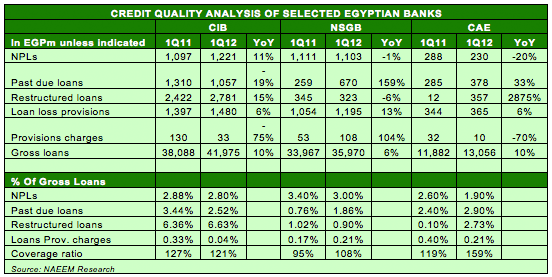
A lot still rides on the USD3.5-billion International Monetary Fund loan which remains in limbo. Conflicting news over the loan has certainly added yet another element of doubt in an already-murky situation.
Cairo-based CI Capital estimates that Egypt needs USD11-billion to fill its massive financing gap.
"The IMF loan is key to Egypt's economy - as it not only supports the widening fiscal deficit and the country's drop in international reserves, but also acts as a vote of confidence in the Egyptian market," said CI Capital in a report.
"However, the current political conflict between President Mohamed Morsy and the Supreme Council for Armed Forces (SCAF), in addition to the delayed cabinet formation, place additional pressure on foreign inflows needed to support the local currency."
DEVALUATION FEARS
The Egyptian authorities have managed to prop up the pound but at the cost of depleting their reserves. While the pound has fallen a mere 4.4% against the American dollar, foreign reserves had fallen 55% over the past 18 months.
But what if the Egyptian government devalues the pound - how would that impact the banking sector?
Bank of America Merrill Lynch certainly paints a grim devaluation picture:
"Devaluation (especially if it is disorderly, large or in an unstable political environment) will precipitate increased dollarization by households (the latter hold USD96-billion in EGP deposits and conversion of deposits to previous dollarization highs would bring in USD demand of USD14-billion, wiping out Central Bank of Egypt's foreign exchange reserves)," said the Wall Street bank.
Meanwhile, CI Capital believes that the CBE will continue to support the Egyptian pound, "but with a low reserves level and the drop in imports coverage to 3 months, the CBE has little room to manoeuvre."
But Naeem's El Haggar believes a devaluation of the Egyptian pound would have a short-term positive effect on banks, as it would immediately inflate their balance sheets and earnings due to a higher Egyptian pound value for the U.S. dollar-denominated assets and income. According to Naeem Research's calculations a 5% devaluation of the Egyptian pound would inflate the assets of banks under coverage by an average of just 1.3%, while 10% devaluation would inflate it by an average 2.5%.
"However, a devaluation would exert pressure on banks' capital adequacy ratios (CARs), as a weaker Egyptian pound would also inflate risk-weighted assets (RWA) (U.S. dollar-denominated RWAs having a higher value in Egyptian pounds) without having the same effect on equity, as most banks' equity is denominated in Egyptian pound."
The research house has stress-tested this for some banks and estimates that a 5% devaluation will lead to a maximum of 25bps decrease in CAR, while a devaluation of 10% will lead to a 50bps decline, with CARs for banks remaining above the 10% minimum required by the Central Bank of Egypt (CBE).
© alifarabia.com 2012