Cairo, May 10, 2010 -- Palm Hills Developments (PHDC.CA on the Egyptian Exchange), Egypt's premier real estate developer, reported a sharp 75% rise in net income to EGP 107.1 million (US$19.4 million) as it announced today its consolidated financial results for the first quarter of 2010.[1] PHD recorded net sales of EGP 198.0 million (US$ 35.9 million) in the three months ending 31 March 2010, a rise of 52% year-on-year on the back of growing sales and newly recognized built-up areas.
Notably, PHD's Q1 2010 earnings also include a new recurring revenue contribution from hotel and tourism operator Macor, in which PHD acquired a majority stake in late February 2010.
"The acquisition of Macor was a key component of our drive to see 30% of our revenues derived from recurring sources in the medium term," said Palm Hills Developments Chief Executive Officer Yasseen Mansour, adding, "We expect further news on this front, including developments on our plans for the retail and education sectors, later this year. Also significant in the last quarter was the signing of our strategic partnership agreement with Burooj Properties, which will purchase 425 units of Village Garden Katameya and on-sell them to Egyptian expats living in the Gulf."
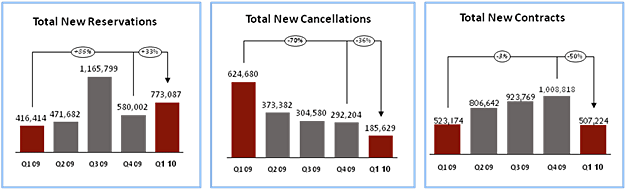
PHD reported a strong rise in reservations (quarter-on-quarter and year-on-year) in Q1 2010, while cancellations continued to decline, said Mansour. PHD's sales backlog as of 31 March 2010 stood at almost EGP 10 billion (US$ 1.8 billion), of which cumulative contracts accounted for EGP 7.7 billion (US$ 1.4 billion) while cumulative reservations accounted for EGP 2.3 billion (US$ 0.4 million).
"We are obviously very pleased with this quarter's results and are now confident that 2010 marks a clear break with the market-wide challenges of last year. Our emphasis going forward will continue to be on the rapid roll-out of new projects; the development of our sales force in Egypt, the Gulf and Europe; the leveraging of competitive advantages through our unrivaled balance sheet; and the continued diversification of our product range and client base," Mansour concluded.
Highlights of PHD's Q1 2010 results follow below, along with management's analysis of the company's performance and an update on operational developments. Full consolidated financial statements prepared in accordance with International Financial Reporting Standards (IFRS) are available for download on www.phdint.com.
KEY HIGHLIGHTS
- Total New Reservations in Q1 2010 stood at EGP 773.1 million (US$ 140.1 million), a 33% rise over Q4 2009 and an 86% increase over the same quarter last year.
- Total New Contracts signed in Q1 2010 were valued at EGP 507.2 million (US$ 91.9 million), the sales effort for the quarter focused on growing reservations for Palm Hills Botanica. Sales at Botanica will only convert into contracts at a later date following completion of regulatory approvals.
- Total Cancellations declined 70% year-on-year (and 36% quarter-on-quarter) in Q1 2010 to EGP 185.6 million (US$ 33.6 million), reaching back the normal quarterly cancelation values before the crisis.
- PHD's Customer Base grew 6% to 6075 clients at the end of March 2010 on the back of management's strategy of attracting new customers through the diversification of products and the price ranges at which they were offered. New clients accounted for 77% of units sold in 1Q2010.
- Net Sales in Q1 2010 stood at EGP 198.03 (US$ 36.0 million), a rise of 52% year-on-year. The dip in quarter-on-quarter sales owes to the standard variability of sales in the industry, with Q4 2009 having seen a strong emphasis on conversion of reservations into contracts at Golf Views, while in Q1 2010 the emphasis was on building reservations at Botanica.
- Net Profit climbed 75% to EGP 107.1 million (US$ 19.4 million) in Q1 2010 compared with the same period last year, buoyed by nearly EGP 36.6 million (US$ 6.6 million) in other income related to the Macor transaction (and separate from the share of Macor profits consolidated).
- Total Land Bank remained unchanged at 48.8 million square meters.
- Ratio of Bank Debt to Equity[2] rose slightly to 24.1% at the end of Q1 2010 from 21.6% at the end of the previous quarter as new bank debt in the amount of EGP 1.1 billion was largely offset by the successful conclusion of PHD's strongly over-subscribed rights issue, which saw the company's capital increase to EGP 2,096,640,000 from EGP 1,397,760,000.
Operational Highlights of Q1 2010: Building Out a More Diverse Revenue Stream
Sales efforts in the first quarter of 2010 focused on building a strong reservation book for Botanica, where reservations will convert into contracts at a later date pending the finalization of the remaining standard regulatory approvals. Meanwhile, PHD focused in the first three months of 2010 on five key projects aimed at diversifying the company's revenue base; growing and diversifying its client base; and building a balance sheet to continue fueling long-term growth. These developments included:
1) The acquisition of 52%-of Macor for Securities Investments Company in a deal worth EGP 141 million (US$ 25.7 million). PHD subsequently raised its stake to 60% through the cancellation of treasury shares. Macor will become a core driver of PHD revenues from the promising hospitality and tourism segment as it grows its inventory of hotel rooms from approximately 800 today to a total of 1,150 within the coming two years. Macor has controlling and minority interests in the companies that own Novotel Sixth of October, Scarabee Floating Restaurants, Mercure Ismailia Hotel and Novotel Sharm El-Sheikh as well as hotel manager Accor Company Hotels. With a diverse and profitable portfolio and association with the global Accor brand, Macor and PHD will develop a new range of budget hotels in a highly under-served segment of the Egyptian market. Moreover, PHD will continue to pursue five-star hotel properties in partnership with Nikki Beach, Jumeriah, and Taj, thereby significantly enhancing the value of PHD's properties while generating recurring revenues.
2) The signing of an MoU with with Taj Hotels, Resorts and Palaces will see the luxury brand manage three hotels at PHD developments, one each on the North Coast, at the Red Sea resort of Ain Sokhna, and in the historic Upper Egyptian city of Aswan. The first Taj-managed property to open will be a 200-room luxury boutique hotel at Hacienda Bay on the North Coast. The property, set to receive its first guests in 2013, will overlook a Stanford-designed 18-hole championship golf course and include a state-of-the-art spa and wellness center.
3) PHD continues to explore Egypt's promising education and retail spaces as part of its drive to build recurring revenue streams. Management now believes it feasible to build a full-fledged, global-quality university in at least one of its larger developments (Botanica) and is exploring options for comprehensive schools offering international kindergarten through twelfth grade curricula. On the retail front, construction has begun at PHD's first shopping mall, which is located in East Cairo on a plot with a gross leasable area of 27,000 square meters. Management has also engaged an international consultant to guide development of a larger (>100,000 square meters of gross land area) commercial project for West Cairo.
4) Expansion of PHD's client base by targeting middle-income and upper-middle income Egyptian expatriates in the Gulf through a key MOU with Burooj, the real estate arm of Abu Dhabi Islamic Bank. Under the terms of the memorandum, Burooj will agree to purchase 425 units of Village Garden Katameya in East Cairo with a total net value of EGP 290 million (US$ 52.3 million),, after applying the 10% discount rate and without including the price of the parking slots for each unit which is estimated to be EGP 60,000 (US$ 10.9 thousands) and maintenance fees implying an average price of EGP 3,777 [US$ 684.5] per square meter). Fifteen percent of the value of the agreement will be due at signing, with the balance paid in quarterly installments over a five-year period. PHD and Burooj are studying other potential partnerships, and the MOU gives PHD the right to open a sales office in an ADIB branch of its choosing. ADIB will provide mortgage finance packages to potential buyers with interest rates lower than those offered in Egypt.
5) Successful conclusion of rights issue. The first phase of PHD's EGP 698.88 million (US$ 126.65 million) rights issue was nearly 99% subscribed. A second phase to cover the remaining 1% was more than 500-times oversubscribed, with the company's capital thereby rising to EGP 2,096,640,000 from EGP 1,397,760,000. While domestic financial institutions clearly see PHD as capable of taking on additional debt, management has set a ceiling debt:equity ratio of 40% for real estate development activities.
Financial Performance
The 52% increase in net sales in Q1 2010 to EGP 198.0 million (US$ 35.9 million) included, more than EGP 1.8 million (USD 0.33 million) in profits from Macor for the period 1-31 March 2010, and was backed by newly-recognized built-up areas (BUAs).
The largest contributor to sales in Q1 2010 was the Golf project (Sixth of October area) at EGP 80 million (a rise of 238% year-on-year), followed by Golf Extension project (Sixth of October area) at EGP 70 million (US$ 12.7 million) and Palm Hills Katameya at EGP 20.3 million (US$ 3.7 million). Notably, high land and construction overheads on Golf Views and Golf Extension as well as the naturally high construction costs associated with apartment units delivered from Bamboo saw a sharp increase in COGS, which rose 333% to nearly EGP 91.3 million (US$ 16.5 million).
The rise in COGS and a 44% increase in SG&A spending saw EBITDA ease 19% year-on-year to EGP 65.4 million (US$ 11.9 million). SG&A climbed on the back of increased salary and wage expenditures resulting from both new management depth added in the second and third quarters of 2009 (and thereby not reflected in the Q1 2009 comparative) and standard wage rises. Also included is the acceleration of advertising spending that began in the fourth quarter of last year with expansion of outdoor advertising and PHD's first regional television campaign.
Bottom-line growth was supported by EGP 36.6 million (US$ 6.6 million) in other income (derived from the Macor acquisition, but unrelated to the consolidation of PHD's share of Macor's profits), a 59% rise in interest income to EGP 51 million (US$ 9.2 million) (on the back of an increase in notes receivable and consequent rise in net present value [NPV] discount), and an 86% drop in income tax expenses as the majority of sales were from tax-exempt projects.
Land Bank
The size of the land bank remains unchanged at 48.8 million square meters in at the end of Q1 2010 compared with Q4 2009. PHD's focus in the first quarter, as it was in 2009, was on the execution of existing projects. Management's goal is to capitalize on current favorable cost-saving conditions, boosting EBITDA margins and decreasing construction costs on in-progress projects. Nonetheless, the company remains diligent regarding the pursuit of compelling land acquisition opportunities that complement its existing developments.
Management has contracted with leading global real estate consultancy CB Richard Ellis (CBRE) to periodically revalue Palm Hills Developments' land bank. After finding in October 2008 (results released in January of 2009) that PHD's land bank had increased in value by 70% to EGP 33.1 billion (US$ 6 billion), CBRE found in its October 2009 valuation (released 10 March 2010) that the market value of PHD's properties as at 31 October 2009 was EGP 38.1 billion (US$ 6.9 billion). This most recent revaluation showed a further increase of 15% in the value of the PHD's land bank. Both valuations were undertaken in accordance with the standards of the Royal Institute of Chartered Surveyors Valuation Standards, Sixth Edition.
Outlook
PHD maintains a very positive view of the Egyptian real estate market and believes strong Q1 2010 results underscore the strong prospects barring exogenous shocks of a sustained recovery in consumer sentiment in 2010.
Sales growth at new distribution points in Europe (London) and the GCC will be driven largely by economic developments in those markets, and management will continue to invest in expansion of those points of sale. Further targeting of middle-income Egyptian expats through arrangements such as that with Burooj would also be welcome developments, as being associated with Abu Dhabi Investment Bank (ADIB) will provide mortgage finance packages to potential buyers with interest rates lower than those offered in Egypt.
PHD's reach and penetration of new market segments is also underpinned by its unrivaled liquidity and strong cash flow, which has allowed it to announce in April that both the newly launched Palm Hills Katameya Extension and a new phase of Palm Parks will see payment terms extended to up to seven years.
Although Egypt's large, fast-growing population, expanding economy, and long-term fundamentals of the fast-developing infrastructure base make the country highly attractive going forward, management also continues to explore interesting opportunities outside Egypt that would allow it to exploit the strength of its balance sheet and of its operational know-how.
As noted above, the growth of recurring revenue streams in all markets and developments will continue to be a priority going forward.
-Ends-
Palm Hills Developments recognizes its villas and town houses revenues from land upon signature of a contract while revenues from construction are recognized on a percentage of completion basis with a minimum threshold of 50%. Revenues from apartments and multi tenant buildings are recognized upon delivery. As a result, total revenues figure on the Income Statement during a period does not reflect neither reservations nor construction revenues from villas and town houses less than 50% completed or any revenues from apartments.
[1] Palm Hills Developments issues its financials in Egyptian pounds (EGP) and advises that those seeking to convert to US dollars do so at a rate of USD 1 = EGP 5.518 for Q1 2010.
[2] Calculated as (Bank Overdrafts + Term Loans) / Total Equity
© Press Release 2010