With a civilization dating back more than 5,000 years, Egypt is one of the oldest tourist destinations on earth. For the past couple of years, however, the country has been struggling to remodel its politics and economy. This has had its effect on several financial sectors, including the equity market and the funds sector.
According to the Zawya Funds Monitor, Egypt had 68 domiciled funds at the end of 2010, with USD 9.50 billion in assets under management. With the stock market growing 15% in 2010, there were clear indicators this upward trend would continue, thus increasing the net asset value and the inflow of capital into the Egyptian mutual funds industry. This is clearly shown through the increase in the number of domiciled funds to 78 at the end of 2011 and 82 as of June 2012.
With a population of more than 80 million people, a majority of them Muslim, Egypt is potentially an attractive market for Islamic finance. Among the 82 domiciled funds, 12 are Islamic and 70 are conventional, ranging from money market, equity, balanced and fixed income, funds of funds, capital guaranteed and capital protected funds.
Gross AUM has risen from USD 7.582 million as of Q3-2011 to USD 8.460 million as of Q4-2011.
By the end of 2010, Egypt was one of the fastest growing economies in the MENA region with 5.1% real GDP growth. But a series of events threw the country's troubled transition to democracy deeper into confusion. Egypt was the 30th largest economy in the world in 2010, according to Economy Watch. However, thanks to centralization and corruption, Egypt is a poor country. GDP per capita was USD 6,200 in 2011, making it 135th in personal income rankings.
Egypt faces significant immediate economic challenges, especially the need to restart growth and address the fiscal and external imbalances after the new government settles in.
But the second largest economy in the Arab world has been as resilient as the centuries' old pyramids.
The investment regime has been stable, but flows have slowed significantly due to the challenging economic and political situation. The Islamic asset management industry is expanding. Islamic funds and investments are expecting an inflow of USD 70 billion from GCC investors by 2013.
Source: Zawya Funds Monitor
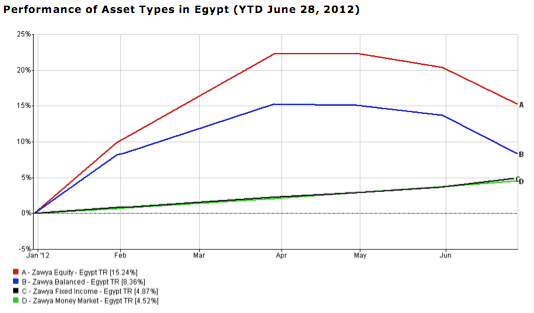
In June 2012, Egypt's stock market had the second-best year-to-date performance in the world, after Venezuela. Salah Shamma, co-head of equity asset management at Franklin Templeton Middle East, said he doubled his fund's exposure to Egypt after the first presidential elections in May, though he retains a "neutral" stance on the country that reflects the level of political risk.
Source: Zawya Funds Monitor
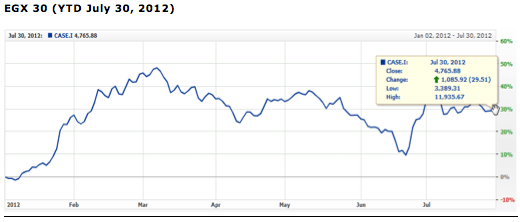
After falling close to 50% in 2011, the stock exchange showed a smart recovery, rising 24% in the first half of 2012. Despite a notable drop in flows from international investors and volumes in general, the EGX 30 stands almost 30% higher from its January 2 close.
"Egypt fundamentally is still a very solid market for investment," Mohammed Omran, the executive chairman of The Egyptian Exchange (EGX), said. "The country experienced 7% growth before the financial crisis and 4.8% during the crisis, when Western economies were struggling. And, as a country of 80 million people, Egypt still represents one of the biggest markets in the Middle East."
With most investors on vacation during July, and Ramadan dealing with August, full trading activity may not be restored before September, as the daily trading hours in Egypt have been shortened. But the first milestone of the second half of 2012 will be the Q2-2012 corporate results, which are expected to be a promoter for the market as well as the mutual funds industry.
Celine Salloum is a research analyst at Zawya.
© Zawya 2012