While investors were looking elsewhere, Dubai and other Gulf markets have been staging an impressive rally.
What's this: a Gulf stock market racking up double-digit growth in the first six weeks of the year?
Dubai Financial Market index had risen nearly 19% year-to-date by February 22, beating other resurging markets across the world and reviving renewed hopes for battered investors.
Only Egypt, with a stellar 38% rise during the current year, seems to be ahead of the general DFM index.
At the moment, DFM appears to be outperforming more illustrious rivals such as HangSeng (up 16.90%), Singapore (13.20%) and even established markets such as Nasdaq (13.18%) and DJIA (6.12%). It's even beating gold (12.13%) and Brent (12.99%) as an asset class, according to Zawya data.
The market has been rising at steady volumes from nearly 300 million on February 16 to 464 million by February 22 - levels that are reminiscent of the heady days of the pre-crash days.
Dubai may be leading the rally, but it's not alone. Saudi Arabia crossed the psychologically important 7,000-point barrier to finish at 9.6% higher by the end of its trading week year-to-date.
In fact, at least five Saudi companies - Savola Group, Al Bilad, Yanbu Cement, BJaz and Taiba - are touching new 52-week highs, according to NCB Capital Research.
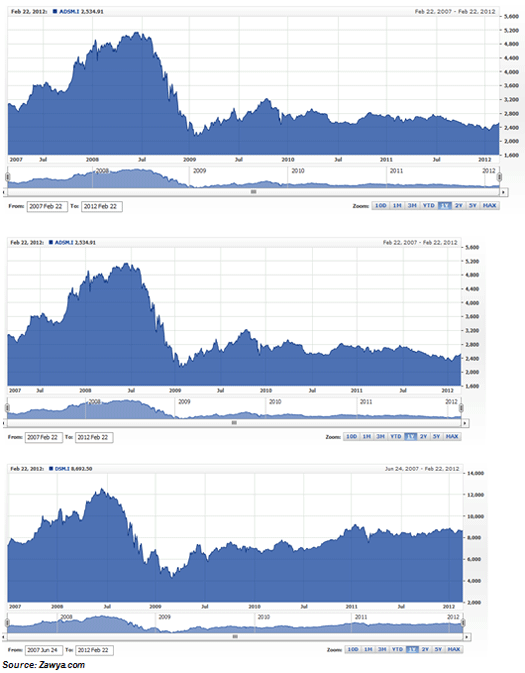
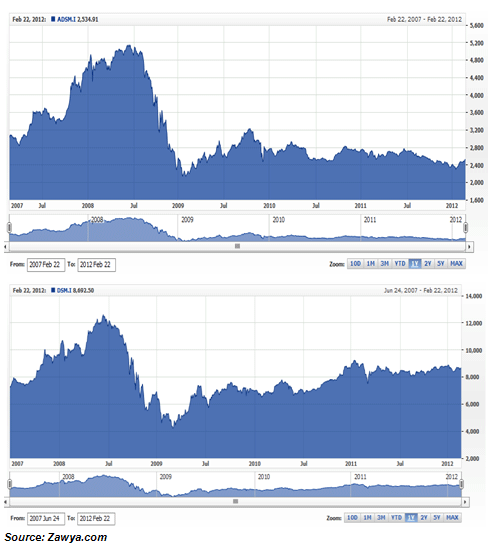
Meanwhile, Abu Dhabi stock market is up 5.5% year-to-date, and while it has lagged behind Dubai, the bourse may be gearing up for a breakout.
"Abu Dhabi Price Index settled at 2,504.17 point (on February 22). The index is still holding a territory that favors a break out of the resistance line at 2,510 point, aiming for a gradual increase towards 2,550 point and 2,620 point," according to Global Investment House's technical analysis.
"The rise above the medium-term (11 weeks) moving average along with a healthy trading activity is currently supporting the constructive outlook; however, a dip below the horizontal line at 2,450 point will diminish the positive momentum and open the space for a retest of the support level at 2,417 point."
Qatar, the best performing Gulf market last year, is in the red, down -1.0% and Oman was a tad submerged, down 0.4% year-to-date.
LOOKING ELSEWHERE
The Dubai FM seems to have outfoxed most analysts, especially as most of them were focused on Saudi Arabia.
"We see attractive investment opportunities across the GCC, but believe Saudi Arabia should be on every investor's radar, especially since direct market access for qualified foreign investors to this market seems just a matter of time, but we also see this market as one of the biggest beneficiaries of high commodity prices and infrastructure spend," Dubai-based Rasmala had in a note on February 13. "Our top picks in the GCC are SABIC and Mobily in Saudi Arabia; CBQ and IQCD in Qatar; FGB, DSI and Emaar in the UAE."
Comparing MENA market 2012F P/E ratios to those of other emerging markets, most of the MENA markets look relatively attractive, especially considering positive view on Qatar's and Saudi Arabia's economies and corporate earnings growth, said Rasmala.
Emerging market fund managers may have also missed the Dubai rally. EFG-Hermes notes that global emerging market funds raised their Middle East Africa exposure to 0.97% in December (from 0.91% in November) led primarily by Qatar, while the UAE and Saudi Arabia saw only small increases in exposure.
Overall, GCC funds saw outflows, primarily from Saudi Arabia and Kuwait.
"MENA country funds recorded negligible outflows in aggregate as a resurgence of inflows into Egypt and, to a lesser extent, Jordan funds (totalling USD28 million) were offset by USD32 million of outflows from GCC funds (primarily Saudi Arabia and Kuwait)," notes EFG-Hermes.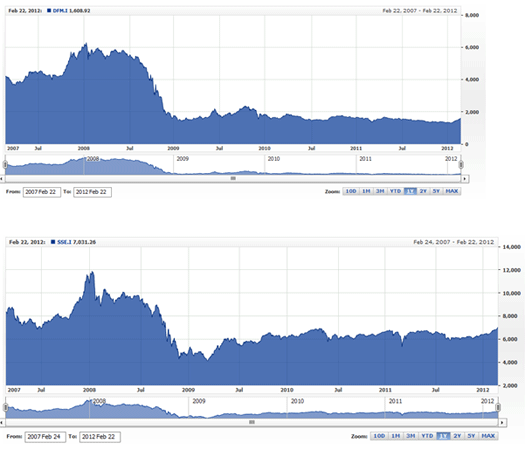
NOT SO FAST
Dubai is benefiting from its corporates' ability to work through their debt and even be bold enough to raise new financing - eg USD675 million by Dubai's Department of Finance for the Sufouh Tram.
Other markets such as Abu Dhabi, Kuwait (up 4.7%), Qatar and Saudi Arabia are benefiting from high oil prices and the stimulus packages that are trickling into their economies.
The regional situation around the Strait of Hormuz seems to be a stalemate. And while Iran and Israel continue to trade insults, a likelihood of an attack on Tehran seems less likely especially as the U.S. seems less eager to be drawn into yet another unwanted war.
With Greece's troubles already being factored into the equation, it will take a fresh negative incident to upset this rally.
Indeed, there are more upsides hovering over the horizon. Investors are keen on Saudi Arabia opening up its market to foreigners and there is the potential that the UAE and Qatar may get the nod from MSCI and they may reach the exalted emerging market status.
While the markets are looking good right now, it could well be a false dawn and things could revert very quickly.
On the negative side, it will take one stray Israeli missile to upset Iran's Islamic regime, plunging the entire region into turmoil and sending oil prices to USD150, thus upsetting a fragile global economic recovery.
Domestic tensions in Saudi Arabia - there is daily news of unrest in the Eastern province - could spread, although will most likely be crushed, especially as Riyadh has warned that any disturbance would be met with an 'iron hand'.
For once, the positive seem to be outweighing the negatives. It's early days yet, but 2012 is turning out to be a promising year.
© alifarabia.com 2012