Sunday, May 20, 2012
--Loan Appears To Breach Central Bank Guidelines
--Dubai Successfully Taps Capital Markets
--ENBD Has "Systemic Size"
By Asa Fitch
Of ZAWYA DOW JONES
DUBAI (Zawya Dow Jones)--Dubai's government has been steadily increasing its borrowing from state-controlled Emirates NBD (EMIRATES.DFM), the largest listed bank in the Arab Gulf by assets, as the emirate seeks new sources of funding at a time when European and other international banks are curtailing lending to the region.
Though Dubai has successfully tapped the capital markets on several occasions since the financial crisis began to bite in late 2008, most recently with a $1.25 billion sukuk issue in April, its borrowing from Emirates NBD has continued to rise. In the bank's last financial statements, the borrowing had reached 62.18 billion U.A.E. dirhams ($16.94 billion), or almost a third of the bank's total loan book, putting it in apparent breach of new central bank limits on exposures to government borrowers. 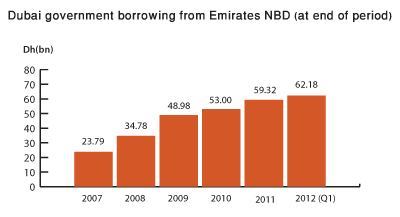
"That number has gone up, and one reason why that could have happened is that other avenues were not available for the Dubai government and government-related entities to get financing," said Shabbir Malik, a banking analyst at EFG-Hermes in Dubai. "There has been a lot of talk about European banks withdrawing from the market," he said. "That could be one aspect of it."
Dubai government spending has remained high, meanwhile, with the emirate focusing on transport infrastructure projects, including a $7.8 billion expansion of its international airport to handle a projected increase to 90 million passengers a year in 2018. Dubai has reined in spending at government departments recently, including a 4.2% cut in this year's budget, but the emirate continues to run a projected deficit.
Financial stress at state-linked companies has also put demands on the government's finances. Dubai World, a government-owned conglomerate, last year finalized a $25 billion debt restructuring, while Dubai Holding, a business group owned by the emirate's ruler, is in talks on another $10 billion debt deal.
The funding needs since the debt crisis helped more than double Emirates NBD's loans to the Dubai government since the end of 2007, when financial statements show lending was worth AED23.79 billion. A further 14% of Emirates NBD's loans at the end of March 2012 were to Dubai government-related entities, and the bank had AED2.2 billion in lending to its parent company, the Investment Corporation of Dubai (ICD). In total, government-connected lending was more than 45% of all loans at the end of the quarter.
Meanwhile, government deposits at the bank amounted to AED1.82 billion, the statements say, while deposits from government-related entities comprised 10% of all deposits.
Emirates NBD is about 55% owned by the Dubai government through ICD, and has shares listed on the Dubai Financial Market.
Credit rating agencies and analysts voice some concern about Emirates NBD's large government exposures, though they are reassured by the belief that Abu Dhabi or the U.A.E. federal government would support the bank if it ever got into difficulties.
"This bank has systemic size," said Jean-Michel Saliba, an economist at Bank of America Merrill Lynch. "Deposit growth is OK, so the bank is standing up, but because of its systemic size if it got into trouble it would be bailed out and supported. That's the thinking. That's partly why the government is using the bank as a financing tool."
Fitch Ratings downgraded Emirates NBD's standalone credit rating two notches last month, pointing to loan concentration and exposure to government-related entities restructuring debt among its concerns. But the agency affirmed its overall "long term issuer default rating" at A+, citing "the extremely high probability of support from the UAE authorities and the emirate of Dubai, given ENBD's substantial domestic franchise, majority ownership by the government of Dubai and the long history of support in the UAE."
"Emirates NBD's concentration risk to the government stands out," said Naveed Ahmed, a banking analyst at Global Investment House in Kuwait. "It is a potential problem ... this could be one of the reasons why the bank [stock] is trading at a low multiple compared to peers."
Emirates NBD's stock has recently traded at less than half of its book value, according to Zawya Dow Jones data. National Bank of Abu Dhabi, meanwhile, the U.A.E.'s second biggest lender, is trading at 1.25 times book.
Emirates NBD's large loan to the government was being used primarily to finance infrastructure development, including additional work on the international airport and other transport projects, according to a person familiar with the matter. The bank was arranging the financing on a commercial basis, the person said, and the Dubai government was not getting a sweetheart deal because it is the bank's majority owner.
The government may also be using Emirates NBD to cover short-term needs as government departments run overdrafts to fund operations when revenues don't match expenditures.
"The public finances of the government are cash based which results in temporary mismatches between revenues and expenses," according to a recently updated government sukuk prospectus. "The government uses overdraft facilities from UAE banks to fund such shortfall and invests any temporary surplus in short-term deposits with UAE banks."
It is unclear what effect new central bank limits on UAE bank exposures may have on Emirates NBD or other lenders who are already in breach of the rules. In a recent directive, the regulator said banks must limit lending to emirate-level governments and government departments to 100% of their capital base. Emirates NBD's lending to the government is about 130% of its capital base as defined under the regulation, according to Malik at EFG-Hermes.
Emirates NBD chief executive Rick Pudner said last month that the bank was discussing the timing and impact of the new limits, which banks have to conform to by the end of September. Malik said if the new central bank regulations forced Emirates NBD to either cut back on or halt lending to the government, Dubai might issue bonds or use other means to fill the gap.
Emirates NBD declined to comment. The central bank and the Dubai government did not respond to requests for comment.
-By Asa Fitch, Dow Jones Newswires, +971 4 446-1685, asa.fitch@dowjones.com
Copyright (c) 2012 Dow Jones & Co.
(END) Dow Jones Newswires
20-05-12 0952GMT