CB RICHARD ELLIS
MarketView
Dubai, UAE
Quick Stats
Change from
Hot Topics
- Around 43% of Dubai's 2011 budget is allocated to the economic and infrastructure sector.
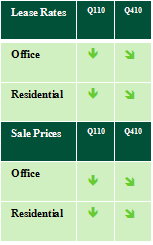
- Annual decline in CBD office lease rates was 33%, with only a marginal change from the previous quarter.
- On average, apartment rates have fallen by 17% over the past 12 months with the highest fall being for studio apartments.
OVERVIEW
Dubai's 2011 annual budget was released with a total planned expenditure of AED33.7 billion. The biggest share of funds, amounting to 43% of the total, was allocated to economic and infrastructure projects.
The ongoing development of infrastructure facilities such as tourism, roads, transport, and airports clearly demonstrates the Government's continued commitment towards bolstering those non-oil sectors which form the main contributors to the Emirate's economy.
An increase in construction activity has been noted over the past two quarters as a number of previously stalled projects have restarted. The development will come as some much needed relief for investors who have seen their investments stall in the midst of a challenging financial environment. Much of the renewed construction activity has been in the master-planned communities of Business Bay and Jumeirah Village.
The Government-backed 'Tayseer' programme, launched last year to support developments facing financial difficulties, has seen a significant increase in the number of registrations. Figures released by the Real Estate Regulatory Authority (RERA) indicate that there are now as many as 114 registered property projects seeking financial assistance.
The initiative is seen as a strong indication of the Government's commitment to safeguarding investor's rights as well as trying to instil confidence in the beleaguered market. However, calls for full publication of cancelled properties have, to date, fallen on deaf ears.
The 2011 Rent Cap Decree was issued in the form of Decree No.2/2011. Article 1 stipulates the limits and permissible percentage increase, whilst Article 2 authorises the 'RERA Rental Index' as the main reference point in determining such increases.
The rent cap system was introduced in 2006 in order to control rental inflation and counter the exploitation of tenants by landlords. However, with the current market being very much 'tenant friendly', the application of the system has been limited.
Dubai's real estate market remained quite stable during the quarter with only marginal changes recorded in lease rates. However, more positive economic indicators are now emerging with encouraging GDP growth forecasts anticipated to be broadly inline with those of Abu Dhabi.
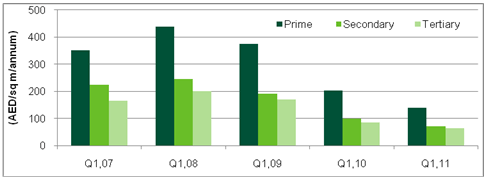
Office Lease Rate Movement (Q1, 2007 - Q1, 2011)
OFFICE MARKET
Office stock continues to see steady growth. The total supply of office space by the end of Q1, 2011 is estimated to be 5.7 million square metres, an annual increase of 17%. New space is emerging from newer masterplanned developments, such as Business Bay, Jumeirah Lakes Towers, TECOM, Dubai Investment Park and Dubai Silicon Oasis. The increase in stock is further affecting lease and occupancy rates across all developments of Dubai.
Lease rates within the CBD, but outside DIFC, are currently in the range of AED1,075 to 1,940/sqm/pa, which reflects a quarterly drop of 3%. With increasing competition in the market some landlords are now offering all-inclusive deals covering rent and service charges, whilst some even cover chiller costs and DEWA charges.
The office sector proved to be very active during Q1 with a significant increase in the number of lease enquiries. The majority of new requirements were for spaces below 500 square metres, but consolidation amongst existing firms has also resulted in a number of enquiries for space of over 3,000 square metres. At this stage, the main focus of demand is very much in the CBD, as a growing number of occupiers look to relocate back into central areas as favourable tenant conditions create opportunities to secure top quality space on affordable terms.
One of the most interesting trends to emerge during the quarter was a discernible reduction in transaction timing with some occupiers clearly ready to move immediately. Beyond the attractiveness of prevailing deals, another potential reason for these abbreviated acquisitions is the political unrest that has unfolded in countries such is Libya, Tunisia and Egypt. We have already seen a number of occupiers freeze regional expansion plans and instead consolidate in more stable locations such as Dubai.
Secondary and tertiary locations that have experienced a substantial drop in lease rates over the last two years have seen some stability in Q1. Lease rates in these areas now range between AED430 to 1,075/sqm/pa with little or no deviation over the previous quarter. However, even at these low rates, many landlords are still struggling to raise occupancy levels amidst weak demand and the sheer volume of supply.
The situation in peripheral areas has led some landlords to opt for building conversions with medical and educational purposes the usual candidates. From an occupier perspective, the limited availability of these services in emerging areas creates an attractive proposition for educational and health providers.
RESIDENTIAL MARKET
The decline in residential lease rates continued at around 4% over the first quarter 2011, although established locations with infrastructure connectivity, facilities and amenities have now seen rates remain steady for consecutive quarters. However, on average, lease rates have dropped by 17% over the last 12 months with the highest fall noted for studio units, which fell by 19%. One and two bedroom apartments have experienced falls of 17% and 16% respectively.
Residential Apartment Rents (Q1, 2008 - Q1, 2011) 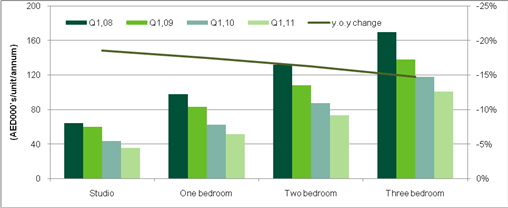
New developments at Silicon Oasis, Business Bay, IMPZ, Jumeirah Village, and Dubai Sports City continue to experience rising vacancy rates and falling rents. Unrelenting new supply and unfinished infrastructure and community facilities are serving to further exacerbate the situation.
Despite a prominent location adjacent to the existing CBD, Business Bay is struggling to attract tenants and faces a battle to reverse huge vacancy rates. Current average lease rates for a one bedroom apartment in the area are around AED55,000/annum, compared to AED75,000/annum in Downtown Dubai for similar quality apartments. This reflects a 36% differential for units just kilometres apart as tenants have proved unwilling to contend with ongoing infrastructure issues and facility shortages.
OUTLOOK
An improving economic outlook is likely to result in improved demand levels as the year progresses, although the sheer volume of new supply, coupled with existing vacancy rates is expected to continue to exert downward pressure on lease rates. Average residential rents are expected to fall by around 8% to 12% during the year as oversupply pressures in new developments continue to force the market down. A more stable outlook is envisaged for developed community projects as tenants continue to upgrade their residences in a market packed with enticing offers.
Mortgage providers are starting to become more visible and active with seemingly liberal offerings emerging. The broad interest rate range still lies between 5.5 to 8%, although a growing number of lenders are quoting rates at the lower end of this scale. Despite an apparent relaxation of terms, many of the 'deals' currently circulating require detailed analysis to fully assess the conditions and restrictions in play. Upon closer scrutiny it becomes clear that low interest rates require large down payments, typically in the region of 40% to 50% of the property value. For most borrowers this is unattainable.
Current prices for real estate are considered to be competitive, with rates similar and in some cases lower to those prevailing in 2006. Further relaxation of lending practices could see momentum grow in the transactional market, but from the bank's perspective any easing of terms has to be weighed against their current risk profile. For the majority of lenders risks are still considered to significant, with the result that mortgages are focused on more secure and high income customers only.
With only a small number of office buildings scheduled for completion in the CBD during 2011, we may start to see occupancy rates stabilise or even rise. Based on existing requirements, properties between Trade Centre and Downtown Dubai could be set for a bumper year, assuming recent enquiries transpire into actual deals.
Although it may be too early to properly assess the impact of unrest in the Middle East, markets considered stable may benefit in the short term at least. The availability of quality properties, competitive rates, established infrastructure, together with safety and security are amongst the main attractions for businesses seeking a stable regional office location.
-Ends-
For more information regarding the MarketView, please contact:
Matthew Green
Head of Research & Consultancy, UAE
CB Richard Ellis, Middle East
Building 6, 8th Floor
Emaar Square
Dubai, UAE
t: +971 4 437 7200
e: matthew.green@cbre.com
www.cbre.ae/research
Mohammed Faheem
Senior Research Analyst
CB Richard Ellis, Middle East
Building 6, 8th Floor
Emaar Square
Dubai, UAE
t: +971 4 437 7200
e: mohammed.faheem@cbre.com
Disclaimer 2011 CB Richard Ellis
Information herein has been obtained from sources believed to be reliable. While we do not doubt its accuracy, we have not verified it and make no guarantee, warranty or representation about it. It is your responsibility to independently confirm its accuracy and completeness. Any projections, opinions, assumptions or estimates used are for example only and do not represent the current or future performance of the market. This information is designed exclusively for use by CB Richard Ellis clients, and cannot be reproduced without prior written permission of CB Richard Ellis.
© Copyright 2011 CB Richard Ellis.
© Press Release 2011