Ibrahim Dabdoub's criticism of Kuwait's economic malaise highlights the banking sector's frustration over lack of government reforms and lethargic private sector growth.
Ibrahim Dabdoub shook up the Gulf's pliant corporate world last week with an uncharacteristic lambasting of the country's economic malaise.
The veteran chief executive officer of National Bank of Kuwait, the country's largest bank, blamed the lack of economic vigour for the bank's poor performance.
"Domestically, a negative outlook is inevitable where government spending remains dormant, tendering of new projects significantly lags and asset values continue contracting as the local stock market considerably underperforms," Mr. Dabdoub said.
NBK is one of the best run banks in the regional industry and Mr. Dabdoub who has been at its helm since 1983, is widely seen as one of the region's most competent financial services captain. The bank, the country's largest, has posted robust growth even during troubled periods in the region's economy, but this long drawn-out political limbo has taken its toll on the senior banker's patience and his bank's bottomline.
Kuwait has seen nine governments shuttle in and out of parliament in six years, and most of its economic plans are collecting dust, as members of parliament bicker and 'grill' ministers in the House.
As governments have paraded in and out of parliament, businesses have suffered. The country that spawned ambitious entities such as Zain and Agility, has steadily fallen behind, and the investment financial services sector remains in a state of disrepair.
Kuwaiti citizens have taken note and taken to the streets even though the country does not suffer from the problems faced by other Arab countries that saw popular revolutions last year. While the protests have been sporadic and largely ineffective, they underscore the citizen's frustration at the political and economic malaise.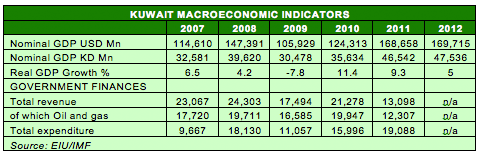
The macroeconomic conditions paint a slightly different picture, however. Kuwait's real GDP grew 9.3% last year and is set to grow another 5% this year, according to the Economist Intelligence Unit estimates.
Oil revenues are rising steadily thanks to high oil prices. Along with Saudi Arabia and the UAE, Kuwait has been increasing production as part of OPEC's drive to keep prices down.
Kuwait's crude production had risen to nearly three million barrel per day by April 2012, compared to 2.3-million in 2010.
"The government will continue to run fiscal surpluses over the forecast period owing to high oil prices and a step-up in oil output," notes the EIU.
The current account surplus recorded a big jump in 2011, reaching an all-time high of KD20 billion, up from KD11 billion in 2010 and equivalent to 42% of GDP, says NBK Capital in a report. This figure exceeded the previous record set in 2008, and stands above the KD12 billion average of the past five years.
"This was mainly driven by a 50% rise in oil exports, which make up more than 90% of total exports," notes NBK Capital. "These exports reached a record KD 27 billion in 2011 as Kuwait export crude prices soared to an annual average of $105 per barrel. Non-oil exports also rose during the year, by some 25%, but their contribution to total exports remains low at 7%."
Meanwhile, at USD55 per barrel, Kuwait's budget breakeven price is one of the lowest in the world - if not the lowest - giving it a comfortable fiscal cushion to kick the reform can down the road.
While the current fiscal breakeven price level is still far below current market prices, the continued increase in the fiscal breakeven price renders the budget more vulnerable to oil price fluctuation, notes the IMF.
Furthermore, if current spending trends continue (e.g., the government's wage bill increased by 20% in FY 2011/12) the fiscal breakeven price is projected to increase further in the medium term.
"If the estimates exclude the investment income from oil revenues and accounts for transfers to the Future Generations Fund (FGF) as expenditure, the budget breakeven price increases by about $20 per barrel," the IMF said in a report on the country.
These factors explain Mr. Dabdoub's frustration.
Apart from its oil prowess, Kuwait barely leads the region in any other important social and economic indices. While the UAE, Saudi Arabia and Qatar regularly fare extremely well in various global economic and social indices and surveys, Kuwait is a laggard.
The country was ranked 67th globally in the World Bank's Ease of Doing Business, while Saudi Arabia is 12th, the UAE 33rd and Qatar 36th. In addition, Kuwait came in 142nd in ease of starting a business, much below Yemen and Syria (data is before the civil war escalated in that country). In addition, the country is ranked 58th in wastefulness of government spending, 118th in burden of government regulations and 113 in government transparency in policymaking.
Developments like Project Kuwait, which were expected to expand the country's oil production are making very slow progress, while other non-oil related developments have not gone off the ground or have long delivery timelines. The idea of increasing oil production by as much as 900,000 bpd was first floated as far back as 1992, remains in planning stage, according to Zawya Projects Monitor.
The project was expected to allow international oil companies to invest in upstream production in five northern oil fields, Abdali, Bahra, Ratqa, Raudhatain and Sabirya, near the border of Iraq. It would have generated foreign direct investment, re-energised the hydrocarbons sector and created jobs. But the project is one of the many victims claimed by the political parties.
Meanwhile, a Kuwait Development Plan launched last year was expected to reduce the country's dependency on oil revenues.
The 2010-14 development plan carries a $104-billion price tag and aims to increase the role of the private sector in the economy. But Citibank notes that the ever-present threat of political tensions re-emerging represents a significant challenge to the government's ability to implement its ambitious investment plan.
"It is unlikely, in our view, that full execution of the plan will occur, with a more realistic scenario of around US$70bn of the projects actually being implemented, at best," noted Citibank in a report last year - and it still rings trye.
Other projects such as Metro Kuwait will only be ready by 2020, while the country has abandoned its nuclear plans, unlike the UAE and Saudi Arabia which have advanced plans to develop the alternative resource.
Among Gulf states, Kuwait realised the greatest decrease of 30% year-on-year in value of awards in the second quarter, reflecting the inability to implement its investment programme and the political difficulties, notes an EFG-Hermes report.
Other indicators don't inspire confidence either. The Kuwaiti Stock Exchange index, which recently lost its position as the region's second largest in terms of market capitalisation to Qatar, is not faring well either.
Qatar's market cap stands at USD125-billion, compared to Kuwait's USD97-billion, according to the latest Zawya.com data. While other regional markets have galloped ahead this year despite intense volatility, the Kuwaiti index remains in negative territory.
INVESTMENT COMPANIES IN DIRE SITUATION
Blame the stock market's malaise to the country's listed investment companies. The International Monetary Fund says there are 15 listed investment companies in "a dire situation."
"These companies had combined assets of $14 billion and total liabilities of $11 billion, of which an estimated $0.22 billion is owed to banks," notes the IMF.
"Their published combined accumulated losses of $1.70 billion have already almost completely depleted their paid-up capital," says the IMF which expects greater losses as more data becomes available.
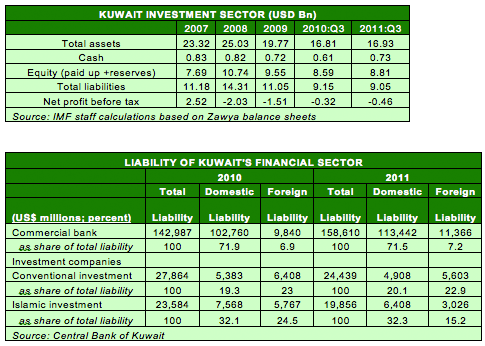
Investment companies remain vulnerable to shocks as they continue to have sizable exposure to international stock markets and regional real estate.
A BANKING RECOVERY IN SIGHT?
The Kuwaiti banking sector is showing signs of recovery, especially as nonperforming loans falls and provisioning rises, notes the Institute of International Finance.
The country's financial services sector was hit hard by the global financial crisis and the domestic deleveraging in a number of its investment banks and companies. However, the sector continues to recover from the global financial crisis of 2008 and a number of legacy issues that remain, including a combination of a surge in non-performing loans and a fall in provisions for NPLs during 2008-09.
Investment companies are of systemic importance because bank lending to the sector still constitute about 9% of total lending by banks--20% of the liabilities of ICs are in the form of domestic bank financing.
"The CBK has required banks since 2009 to provision against nonperforming ICs' loans and to take additional precautionary provisions against weak ICs," the IMF said. In this context, banks have been gradually writing off fully provisioned loans and, as a result, their exposure to ICs has declined in the last two years, from 12% in 2009 to 9% in 2011.
The provisioning continues. National Bank of Kuwait is setting aside USD96.4-million in judgemental provisions to account for a possible deterioration of its operating environment. The bank's net profit fell nearly 40% in the second quarter and 18% in the first half of the year, compared to the corresponding period in 2011.
CONCLUSION
Mr. Dabdoub's exasperation is understandable. Kuwait has all the ingredients to transform the economy: financial muscle and entrepreneurial flair, to make a greater contribution in regional competitiveness and innovation.
But the political deadlock is pushing the country's international profile further back and leading to stagnation due to lack of economic diversity.
There is a good chance that the oil curse would continue to delay reforms further. Kuwait's fiscal situation hardly warrants alarm bells to ring out. The national employment levels remain manageable, while periodic rises in wages in the public sector ensure that protests are going to be limited and largely manageable.
The high oil revenues continue to make fiscal reforms less appealing and still allow the country to post good economic growth. And that's the economic trap Kuwait finds itself in.
© alifarabia.com 2012