Gulf states have pledged $150-billion in response to the regional unrest, according to Bank of America Merrill Lynch estimates. But it may not be enough.
Gulf states have spent $150-billion as response to the regional unrest, according to Bank of America Merrill Lynch (BAML) estimates.
The figure makes up nearly 5% of the six countries' GDP for the year and constitutes around 57% of this year's combined spending.
"This has averted potential disquiet over governance in most countries, though, over a longer-term horizon, economic reforms will be needed to buoy private sector growth and job creation," says BAML in a note.
"We expect the oil boom-led economic diversification program set up after the lost decade of the 1990s to continue over the next decade, unless oil settles in a marked or sustained manner below the regional breakeven price (US$80)."
But in the Gulf states' haste to create jobs, there is a danger of overcapacity in certain sectors.
There are close to $1.8 trillion projects under way in the Gulf, according to Citibank, with close to $600-billion worth of projects in Saudi Arabia alone. Of these, nearly $180-billion are in early stages of development, apart from $130-billion in the UAE.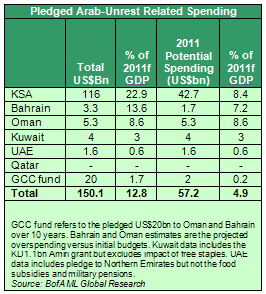
However, there are issues of sustainability in certain countries. While the UAE, Qatar and Kuwait are in good shape to absorb the new spending bills, Bahrain has seen a breakeven price hit $110 per barrel even as its "hydrocarbon resources may be exhausted in the coming decade," notes BAML.
Similarly, "the Saudi government starts running deficits from the next decade onwards and accumulates domestic debt (12% of GDP currently), increasing the oil breakeven fiscal price. In our view, unless current spending is reined in, the introduction of structural reforms (lower subsidies, higher non-oil revenues) will need to be contemplated."
The unrest in the Arab World has also highlighted major issues in the labour market, especially in Saudi Arabia. The U.S. bank notes that while job creation was robust during the boom period, it benefited expatriates disproportionately and failed to address structural employment issues for nationals such as skills mismatch.
"While the renewed Saudization drive seeks to alter labour market outcomes, this will likely impose costs on the private sector. In our view, a longer-term strategy would involve pay, a social safety net, training and employment structural reforms to twist incentives," the bank notes.
6% GROWTH FOR EGYPT
While the Gulf states grapple with, in most cases, issues of excess and surpluses, Egypt is coming to terms with life after the revolt that ousted Hosni Mubarak and his regime.
First and foremost will be job creation, which was one of the central reasons why Egyptian youth turned against the previous regime.
"With the labour force growing at 3% year-on-year, Egypt needs to sustain c.6% growth in the medium term to reduce unemployment. Demographic trends partly explain the fact that labour force growth has outstripped labour demand while structural rigidities and a skills mismatch have contributed to high levels of youth unemployment," notes BAML.
Egypt GDP fell 4.2% year-on-year in the first three months of the year when unrest reached fever pitch, and the interim government is keen to jumpstart the domestic economy.
Egypt will be hoping to attract foreign direct investment, which served as a great source of investments over the past decade. "Egypt has the highest marginal return on capital among major EEMEA countries so attracting FDI again after the 25 January Revolution is key to raising investment levels and accelerating GDP growth," says BAML.
But for FDI to return, the political process will need to be credible and stable. The country is expected to have parliamentary elections in November and subsequent outcomes of that event will determine the investors' interest.
Cairo-based Jazeera Securities Brokerage lays bare the political challenges facing the country: "The Egyptian citizens have been in a state of confusion since January 11, with so many variables are in motion, in a pace, that they are not accustomed to. And will get even more confused with around 35 parties are either registered or attempting to register, in time for the elections. Out of these parties at least 10 are non-secular parties."
Once the structure of the parliament is confirmed, the degree of uncertainty regarding the shape of the Egyptian political future, will start to subside, "and with us putting the odds at 4:1, that it turn for the better, we expect the state of congestion in the economy and individual spending will start to unwind, at an accelerative pace, by early 2012,' notes Jazeera,
There is also the fear that the new government will focus on people-friendly policies which may not be in the best long-term interest of the country.
"Populist policies risk deterring foreign capital and demand; both are required to accelerate growth and spur job creation, so are an overarching constraint," says BAML.
"Our base case is that the accountability of an incoming government will eventually lead to the recognition of the need for policy reprioritization along pragmatic lines. However, there are risks associated with this view and we do not exclude an interim period of uncertainty and volatility."
© alifarabia.com 2011