Markets were focused on the US in May. A combination of stronger economic data and the effect it could have on the trajectory of the US Federal Reserve's (Fed) current quantitative easing program led to falls in a number of emerging-market indexes and a rise in bond yields.
US risk-asset outperformance lent strength to the US dollar, which rose against most other currencies (with the Chinese renminbi a notable exception). The Malaysian general election results at the beginning of the month saw the ruling party retaining power. The election result gave a short boost to the ringgit, although the currency fell in value against the US dollar over the month as a whole, in common with other Asian currencies, as the increasing belief that the Fed would taper its bond purchases boosted the value of the US currency.
While risk assets in oil-importing countries in the Middle East and North Africa (MENA) region continued to be relatively weak, assets in many Gulf Cooperation Council (GCC) countries fared quite well in May, reflecting buoyant economic sentiment in spite of the drop in hydrocarbon prices. The headline purchasing-manager index (PMI) for the United Arab Emirates (UAE) rose to 55 in May, its highest reading this year thanks to strong output and an increase in new orders, which point to growing momentum in the non-oil sector.
UPBEAT SENTIMENT
Within the UAE, Abu Dhabi revealed new financial legislation designed to facilitate a new financial hub there, while Dubai reported a large increase in tourists and transit passengers using Dubai's international airport and hotels along with plentiful signs of the continued revival of Dubai's real estate market. Sentiment was further helped by comments from Masood Ahmed, director of the International Monetary Fund's (IMF) Middle East and Central Asia department, who said his organization was not worried about Dubai's ability to meet its upcoming debt obligations.
The positive sentiment could be further boosted if, as many expect, MSCI decides to lift the UAE market from 'frontier' status to 'emerging market' status in June. Saudi Arabian assets also did well as that country's headline PMI remained one of the highest in the world, showing that the Saudi non-oil economy continues to expand thanks to firm domestic demand.
Some chinks of light also emerged in Egypt for the first time in months. Although the political scene remained unsettled, the government managed to promulgate a new tax law and to pass a budget for the coming financial year, both seen as prerequisites for the release of a long-delayed USD 4.8 billion loan from the IMF.
Inflation pressures remained elevated, but the May PMI suggested the sharp drop in output seen in previous months was easing, while Egypt's foreign reserves rose in April, thanks to a USD 2 billion cash deposit from Libya. President Mohamed Mursi also approved a law allowing the state to issue Islamic bonds in a bid to bolster the country's fragile finances.
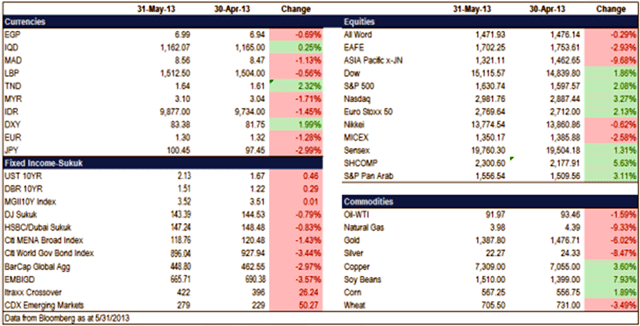
As the market tried to interpret the Fed's signals about when and how it would begin tapering off its current quantitative easing program, the rise in yields during May had a ripple effect on some other fixed-income classes. The nearly 50 basis-point (bp) rise in Treasury rates caused major declines in fixed income indexes such as the Citi World Government Bond Index, the Barclays Global Aggregate Index as well the JP Morgan Emerging Market Bond Index Global Diversified (EMBIGD). While also lower for the month, the Citi MENA Broad Index's decline of 1.43% was significantly lower than the declines of around 3% in the noted indexes.
RATINGS CHANGES AND ISSUANCE
Standard & Poor's (S&P) raised Saudi Arabia's credit rating outlook from 'stable' to 'positive' due to an improved outlook for growth in the Arab world's biggest economy. S&P also hinted that Saudi Arabia's AA- sovereign rating may be raised in the next 24 months if economic growth "remains strong."
Also in the GCC, a strong fiscal framework and healthy external balance meant that S&P affirmed Qatar's AA/A-1 sovereign rating with a stable outlook. While reaffirming Abu Dhabi's AA sovereign credit rating with a stable outlook, the agency pointed to the continuing strength of the emirate's finances, which allow for exceptional fiscal flexibility.
By contrast, S&P cut Egypt's long-term credit rating from B- to CCC+ and its short-term rating from B to C, with the ratings agency citing its concerns about Egypt's ability to meet financial targets and maintain civil peace.
May was a strong month for bond issuance, with USD 3.4 billion worth of bonds being issued in GCC countries. Banks were particularly active in issuing subordinated debt. The most notable issue was a USD 1 billion Tier 1 perpetual (six-year non-call) bond from Emirates NBD at a final yield of 5.75%. Abu Dhabi Commercial Bank (rated A1 by Moody's, A by S&P, and A+ by Fitch with a stable outlook) priced a CHF 150 million minimum 10-year non-call five-year lower Tier 2 note at a spread of +150 bps over mid-swaps as well as a USD 300 million 10-year non-call five-year Tier 2 bond at a yield of 3.178%.
In senior debt, the Commercial Bank of Dubai (rated Baa1 by Moody's and A- by Fitch) issued a USD 500 million 3.375% five-year note at a spread of +250 bps over mid-swaps. In the sukuk space, the Saudi Arabian property-development company Dar Al Arkan issued high-yield debt, a USD 450 million five-year sukuk at a profit rate of 5.875%. A Saudi utilities company also issued a local-currency sukuk.
GCC OUTLOOK POSITIVE
The divergence between the market and economic performance of GCC bond markets and the performance of the rest of the MENA region during May underpins, we think, the benefits of investing in the GCC as a distinct region and its potential benefits.
While bond yields did rise in May, the Citigroup MENA Broad Bond Index declined far less than major global bond, emerging-market bond, or credit market indexes in May. Looking at the market since the beginning of this year, GCC bonds have delivered competitive returns relative to major fixed-income sectors. In our view, the strength of data from the GCC economies also underpins the solid fundamentals that have continued to benefit most regional issuers.
Our outlook for GCC markets remains positive as these markets' fundamentals appear strong in spite of the recent fall in oil prices. We note Saudi Arabia's efforts to address the generous consumer and welfare subsidies that distort the Saudi economy and its moves to increase the employment and employability of its own population.
Initiatives in Saudi Arabia are being replicated in other GCC countries, including the UAE and Kuwait. During May, the IMF forecast a moderation in economic growth across the Middle East this year, mainly due to the scaling back of increases in oil production and modest global demand for the commodity.
Expected growth remains nonetheless healthy and conducive to future performance relative to other regions, in our view, with the growth of non-oil sectors within GCC economies continuing apace, buoyed by the improving health of the financial sector and solid consumer demand.
Mohieddine Kronfol is responsible for the investment process, research and performance of the Global Sukuk and MENA Fixed Income Team at Franklin Templeton Investments, where he is chief investment officer.
© Zawya 2013