The world needs fresh supplies of around 1.4 million barrels of oil per day every year just to keep prices steady, according to Bank of America Merrill Lynch.
But supply is not forthcoming so easily.
While North America has been leading crude production, many parts of the world are facing declining output levels. This is especially true for major producers like Iran, Mexico and Brazil which have seen their output decline for various reasons.
Excluding Nigeria, Iran and Libya, OPEC spare capacity outside Saudi Arabia sits at just 700,000 barrels per day.
"On our estimates OPEC-11 spare capacity will likely stay minimal given a dearth of new projects in the next five years: Kuwait, Qatar and Ecuador have no projects planned at all, and we see limited growth from Algeria," said Sabine Schels, an analyst at BAML.
"New projects in Angola, Nigeria and Venezuela could suffer from chronic delays, shortfalls and a bad security climate. UAE growth will likely be marginal. More importantly the capacity gains we expect to see in Saudi Arabia will likely only mitigate the declines of existing fields," the analyst noted.
Indeed, OPEC production has been falling.
The UK-based Centre for Global Energy Studies says the group's crude output fell by 130,000 bpd in January to reach 30.315 million bpd - its lowest level since October 2011.
"Saudi Arabia's production remained only slightly above 9 million bpd, with liftings boosted by withdrawals from storage.... Libya's oil production fell to 1.25 mbpd, a level last seen early in 2012, as labour unrest hampered both exports and production," said CGES in a note.
An OPEC monthly report forecasts a drop in non-OPEC Middle East oil production in 2013 to an average of 1.49 million bpd -- a decline of 10,000 bpd compared to 2012.
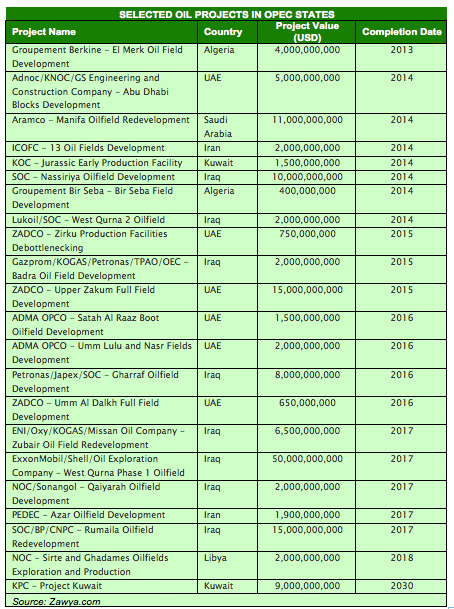
The table above shows most of the projects in major Middle East countries are well into the future and subject to delays.
IRAQ: GLOBAL ENERGY PLAYER?
With global oil supplies declining as global sentiment improves, Brent crude benchmark has remained stubbornly in the three-figure range for sometime now.
Iraq, which has 143 billion barrels of crude reserves - one of the largest in the world - finds itself in an enviable position to fill the impending supply-demand gap, and emerge as an influential player on global oil demand.
"The country boasts many advantages in terms of geography (easily-accessible, onshore reservoirs that are located in under-populated, flat terrain) and geology (uncomplicated and large, with above-average drilling success rates) that make oil development attractive (lower cost of wells, pipelines and other infrastructure)," said BAML's Schels.
Indeed, Iraqi reservoirs are considered the least-expensive in the world, in terms of capital costs per unit and operating expense.
"Iraq's energy sector holds the key to the country's future prosperity and can make a major contribution to the stability and security of global energy markets," said the International Energy Agency in its report on Iraqi oil prospects last year.
But the country has its own host of problems to contend with. The authorities have scaled back their ambitious production plans on the back of limited infrastructure and political tensions.
The government now expects to reach nearly six million barrels per day by 2015, and around 10 million bpd by 2020. Even these seem ambitious.
The country recently reached three million bpd recently, and doubling production over the next three years seems a tough task.
BAML analysts, which did a field-by-field estimate for Iraq, forecasts the country's output to average 4.3 million bpd in 2015, rising to 4.9 million bpd in 2017.
Much of the problems lie with the poor contract deals signed with foreign companies, which have not been beneficial for them.
"Such weak economics are prompting some international oil companies (IOCs) to opt out of their stakes," says Schels. "Already Statoil has withdrawn from West Qurna 2 and ExxonMobil has warned the government they may leave West Qurna 1. Baghdad is currently undergoing a round of renegotiations on production plateau rates in order to improve contract economics for the IOCs."
Then there is the major dispute between Iraq and Kurdistan which has emerged as a huge overhang on the oil sector, forcing oil majors to take sides.
"In a blow to Iraq, oil majors including ExxonMobil, Statoil, ConocoPhillips, Eni and BG, all with operations in southern Iraq, have been showing increasing interest in the north. The Kurds continue to defy Baghdad, developing their oil sector and even allowing for exports by road."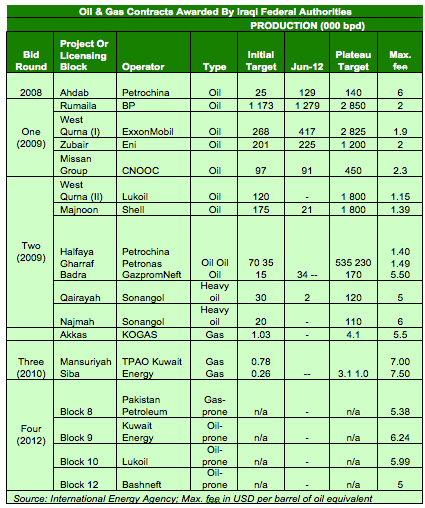
A hydrocarbons' law has been in the works for years and is currently in parliament, but few analysts think it will be signed off soon.
"It is at the bottom of the government's list," Adnan Al-Janabi, a leading Sunni figure, told Reuters. "The centralists of the ruling party have no interest to sustain a federal policy or pass a federal law. Therefore the government and IOCs (independent oil companies) will continue the risk of working in a legal vacuum."
The country's infrastructure is also a major constraint. Iraq's exports to Turkey - its biggest customer - are hamstrung by pipelines that are operating below capacity. Other pipelines heading south are operating far below their nameplate capacity too, serving as a great disincentive for oil majors to ramp up production.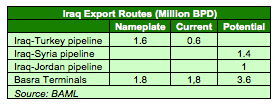
"In addition to export capacity, the lack of water resources used to maintain reservoir pressure must also be addressed," said Schels. "The long-awaited Common Sea Water Supply project, from which ExxonMobil recently exited, has now been pushed back from 2015 to 2018, but will be critical for meeting production growth targets."
© alifarabia.com 2013