Mobile subscribers in Middle East countries reached 367.5 million, with Egypt's Vodafone Egypt, Mobinil and Etisalat Misr are the Arab World's largest cellular operators by subscriptions, according to Arab Advisors Group.
"Between December 2009 and August 2012, two new cellular operators and five MVNOs launched their operations in the Arab World," the AAG said in a report. "Moreover, one cellular operator stopped providing its services."
Given that the Middle East's population stands at around 390-million, that is an incredibly high penetration rate.
This is especially true for Gulf markets, where mobile penetration rates are among the highest in the world.
The UAE's mobile penetration rate is set to grow to around 245% by 2014, according to Shuaa Capital estimates.
The Gulf's high mobile telecom penetration rates and the introduction of competition over the past decade have forced incumbent operators to find new markets for growth.
"Government-backed telecommunication companies, which operated as monopolies prior to the introduction of competition, continue to serve as the dominant service providers in their respective countries." said Shuaa.
"While governments also hold sizable stakes in the second and third operators in their countries, regional players often serve as the major and/or founding shareholder for such companies, with Wataniya in Kuwait (majority-owned by Qtel) and Mobily in Saudi Arabia (set up by Etisalat) offering good examples."
ICT READY MARKETS
Such astonishing rates and focus on the sector has propelled Gulf markets to become some of the most ICT ready in the world.
Bahrain is the region's most ICT-ready country in the region, and the world's 27th most ICT advanced country, according to the Global Information Technology Report 2012, published by the World Economic Forum.
Qatar is a notch below Bahrain, ranked 28th globally out of 142 nations.
"As in the case of Bahrain, the emirate has managed to create one of the best environments for entrepreneurship and innovation worldwide (2nd). This, coupled with the government's strong commitment to boosting ICT-related infrastructure (27th) and spilling over the effects across the economy (34th) and society (21st), has allowed the country to rank in the top quarter of our sample."
Other nations such as the UAE (30th), Saudi Arabia (34th) and Oman (40th) fared well. Only Kuwait, at 62nd, was the only Gulf nation not in the top 50.
WHERE'S THE GROWTH GOING TO COME FROM?
Such high penetration rates mean regional telecom companies are struggling to grow and looking at ever-increasing narrowing margins.
But while Gulf telcos have done extremely well in offering basic services, they still have a long way to go to offer broadband mobile services.
Indeed, while countries such as South Korea (78%), Sweden (71.7%) and Japan (64.6%), have high mobile broadband penetration rates, Gulf countries don't even boast half that figure.
That's where the true growth lies, especially as mobile broadband services can be cheaper and simpler to deploy than full-scale wired communications networks, says the WEF in its comprehensive report.
The number of cellular mobile broadband subscribers jumped almost 60% in 2010 to reach 558 million worldwide; this number should top 2 billion by 2015, according to report.
"For people in many parts of the world, mobile broadband offers the first-ever means of accessing the Internet. And for many, particularly in emerging regions, mobile broadband will likely be their only means of access," the report noted.
"At the same time, it is rapidly becoming integral to modern life for people in more developed countries, continually opening up new Internet experiences and unlocking new opportunities. In short, mobile broadband has become a force for change across all socioeconomic levels and in every corner of the globe. In many profound ways, this technology is an economic development tool for the 21st century."
This was evident during the Arab Spring where access to the Internet via phones led to public debates and citizen uprising that toppled at least four regimes in the region.
While politically threatening to the status quo, the march of the Internet via phone is unstoppable. For regional companies, broadband is the major source of future revenues especially as revenues from voice continue to fall dramatically.
"Given the combination of low penetration and higher margins offered by value-added services, services such as mobile broadband internet are rapidly becoming a key focus area for regional telecom players as a means to drive future growth and improve profitability," notes Shuaa Capital.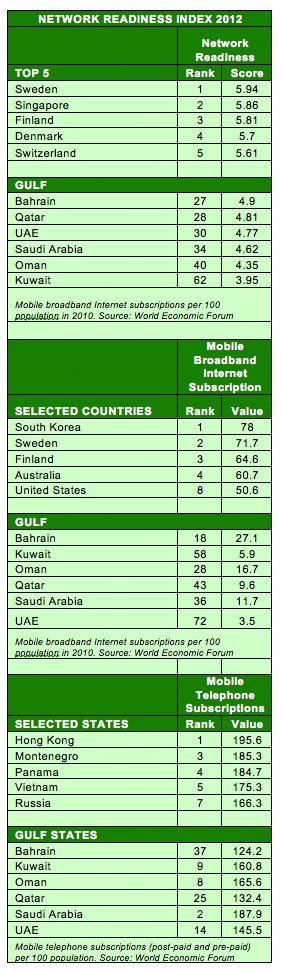
© alifarabia.com 2012