While their global counterparts slash and burn, Gulf banks are collectively set for their best year - ever -- according to KAMCO.
While major blue-chip banks across the world are cutting back, shedding staff, deleveraging and recoiling at the thought of major sovereign defaults in Euroland, Gulf banks have quietly bulked up. Their prudence has allowed them to escape much of the crisis facing the global financial services industry, and they have benefited from great government support that has ensured they lived through the soul-crushing global financial crisis of 2008.
"Notwithstanding the sector's policy to maintain a safe level of provisions along with cautious strategy in extending loans to certain sectors, the combined net profit of banks in the GCC region is expected to grow further at 15% during 2011 to a record high of $21-billion, and therefore exceeding the $20-billion profits recorded during 2007," notes a Kuwait-based KAMCO report on regional banks.
Oil prices have certainly helped and so has the fiscal stimulus in the Gulf, including salary hikes and greater money flows sloshing around in the system .
Analysts expect new infrastructure spend especially in Saudi Arabia, Kuwait and Qatar will stimulate lending and spur banks and the private sector into spirited action.
Still, creditors have long memories. It was only a few years ago when high profile companies such as Dubai World and Saad and Gosaibi Group defaulted, and liquidity vanished from the markets as lenders lost all their appetite for risk.
The result is a lending malaise that persists to this day despite greater improvement in economic fortunes of most of the Gulf states.
But while parts of the Gulf remain oasis of stability, banks are climbing a wall of worry with tensions in Arab Spring-swept countries, renewed Iran-Israel conflict, and the biggest threat of them all - an economic recession in the Euro zone.
KAMCO expects brighter days ahead, with improvement in credit growth especially in Qatar, Saudi Arabia, and Oman in the last quarter of this year and throughout 2012.
"Credit facilities for the whole banks in the Gulf region are expected to reach by the end of the current year $750-billion, representing an annual growth rate of 8% during 2011 fuelled by the robust growth in Saudi Arabia and Qatar which are forecast to add further $22-billion and $19 billion in 2011, respectively."
In Saudi Arabia, credit growth is at two-year highs and has accelerated to 8.7% year-on-year in August, the highest since April 2009 and is expected to record 12% during 2011.
In Qatar, credit growth remains robust at 18% year-on-year in August and is forecast to continue throughout the coming year; credit facilities extended by Qatari banks grew at 18% in September, year-on-year, and are expected to continue their upward trend to grow at 22% during full year 2011.
The UAE and Kuwait will be laggards, with both markets hamstrung by the inconsolably poor prospects of their property markets. Kuwait is also suffering from political delays, deleveraging and weak demand, while Dubai's debt continues to keep the free-wheeling economy in check and creditors nervous.
Ratings agency Moody's has all ready taken note and has tagged the UAE's banking sector with a 'negative outlook', citing ongoing trends of corporate de-leveraging, asset quality challenges and the subdued profitability of UAE banks in the wake of continued provisioning needs.
"Moody's negative outlook on the UAE banking system is mainly driven by the legacy asset quality challenges related to the ongoing restructuring of some large government-related borrowers," says Khalid Howladar, Vice President -- Senior Credit Officer at Moody's.
"Limited transparency, sizeable related-party exposures and high loan and deposit concentrations will also continue to render many UAE banks vulnerable to name-specific risks," Mr Howladar adds.
While Abu Dhabi banks will benefit from spending by the capital, Dubai banks will have no such luxury.
Moody's also highlights the $10-billion 'distressed debt' of Dubai Holding entities, and smaller debts of governmental institutions that need to be worked out, although the $25-billion Dubai World restructuring in June is a positive sign.
"The rating agency expects work-outs of large distressed GRI exposures to continue pushing up system-wide non-performing loans, which are likely to peak at around 13-15% in Dubai next year and around 8-10% in Abu Dhabi this year.
Overall, the rating agency expects bank lending growth to remain subdued over the remainder of 2011 at around 3-5%, compared with 25% in pre-crisis times. Among Abu Dhabi banks, Moody's expects stronger economic growth to generate higher lending growth compared with Dubai banks.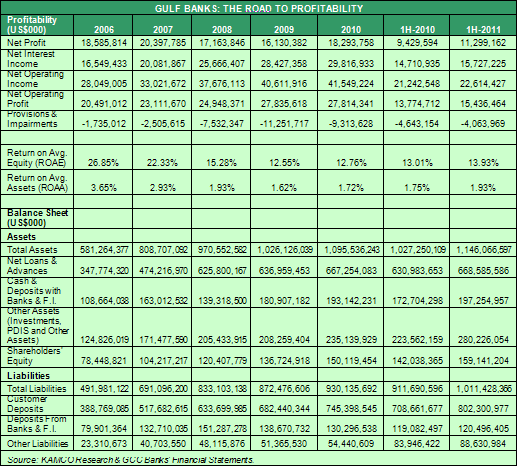
SAFE AS SAUDI BANKS
Saudi banks are at the opposite end of the risk spectrum and is seen as the safest in the world, according to Standard & Poors.
"We believe that there are no major economic imbalances, like a credit fueled asset bubble, that pose a threat to the banking sector,": noted S&P as it ranked Saudi banks alongside those of Singapore, Germany, Singapore, Norway and Sweden.
While private sector credit growth decelerated further in September, rising only 0.4% M-o-M, versus 0.7% M-o-M growth in August, owing to seasonal factors, analysts expect growth momentum to pick up pace in 4Q2011 on the back of project finance activity.
The Saudi banking sector is the most profitable in the GCC region contributing to around 38% of GCC banks' 1H-2011 combined net profits.
However, third quarter results were a bit of a disappointment. Aggregate earnings at main Saudi banks declined by 5.3% Q-o-Q, partly due to strong provisioning at Arab National Bank, Saudi British Bank and Saudi Arabian International Bank.
"Fee income is estimated to have been impacted by seasonality," says Egyptian bank EFG-Hermes.
"Key positive surprise was from SHB & Al Rajhi, which reported strong improvement in net interest spreads. SABB, ANB and SAIB were the key disappointments, with earnings impacted by high provisioning, in our view."
GAS, NATURALLY
Qatar's banking sector is widely expected to post double-digit growth this year and make up 18% of the GCC financial sector profits this year, according to KAMCO estimates.
The sector seems on track to meet that target. Commercial Bank of Qatar saw net profits rise 9% year-on-year at the end of the third quarter on higher net interest income and fee income.
Meanwhile, bellwether Qatar National Bank, did even better posting a 31.8% rise in profit year-on-year. As largest corporate bank with close ties to the government, QNB is poised to be the biggest beneficiary of the country's investment and spending spree that is set to keep the economic engine humming right till the 2022 FIFA World Cup being held in Doha.
WEAK LENDING ENVIRONMENT
Kuwaiti banks have fallen behind peers since 2008, weighed down by high levels of provisions and impairments; with a net profit of $1 billion, Kuwaiti banks share of profits dropped to 9% in 1H-2011.
Nevertheless, National Bank of Kuwait, ever the stalwart, posted impressive profits beating analyst forecast. The bank saw net profits up 20% in the third quarter, but the bank continues to be in a weak lending environment and also has to contend with Al Watany, its Egyptian subsidiary which is weathering the upheavals of the North African economy.
NO LAGGARD, OMAN
After a brief period of turbulence earlier in the year which threatened to shake up Oman's political status quo, the economy, and at least the banks, have come roaring back to life.
Third quarter results of the four key banks - Bank Muscat, Al Ahli Bank, National Bank of Oman and Bank Sohar - show a collective rise of 12% in the third quarter, and 28% year on year.
"Driven by abundant liquidity, increasing disposable income and higher government spending, Omani banking sector stocks under our coverage continue to post strong balance sheet growth," notes Manama-based SICO in a note to clients. "A 30.6% Y-o-Y deposit growth and a 16.5%YoY lending growth in 3Q11 contributed to an 11.5% Y-o-Y total asset growth."
While the EU crisis and regional tensions will keep sentiment in check, the fundamentals in Oman remain intact with the country enjoying strong GDP growth contributed by high oil prices and incremental government spending. The Omani banking sector's performance over the first eight months of 2011 reflects the improving economic activity seen in the Sultanate," says SICO.
NOT BANKING AS USUAL IN BAHRAIN
Bahraini banks have not been immune to the political crisis in the country, but have managed to keep up appearances. National Bank of Bahrain managed to improve net profit by 10% in the third quarter, even though lending fell by 12%.
SICO notes the bank has a 'batten down the hatches' approach, alluding to the great challenges facing the sector.
Moody's has a negative outlook on the country's banking sector due to deteriorating fundamental credit conditions in this sector over the next 12-18 months.
"However, whilst Bahraini retail banks exhibit high regulatory ratios, some smaller banks exhibit very weak asset-quality track records," notes Christos Theofilou, an analyst with the ratings agency.
CONCLUSION
The GCC banks robust growth - for the most part - has not translated into robust lending practices, benefiting the wider economy.
Still, the argument could be made that banks have been repairing their balance sheets after they were shot to pieces in the aftermath of the global financial crisis in 2008.
And while that's cold comfort for small businesses unable to get loans, it does hint that when the global economic sentiment turns positive - and it will at some point next year - the GCC banks will be perfectly positioned to help boost the private sector.
© alifarabia.com 2011