What are the best and worst performing markets in the MENA region, according to Zawya.com data?
Damascus Stock Exchange was the worst performing market in the region, plunging 40% in the first six months of the year, according to Zawya.com data. The tiny stock exchange with a market cap of $1.9-billion has suffered on account of the deteriorating political condition in the country.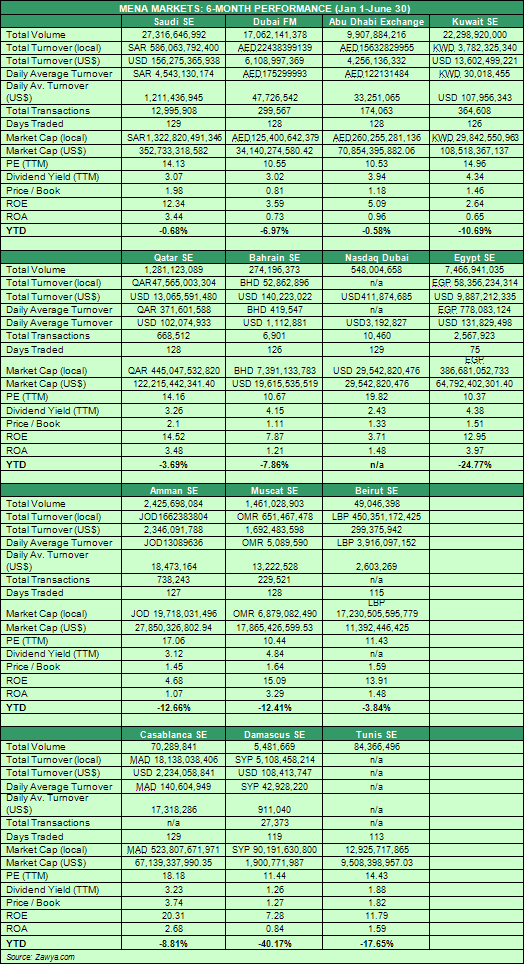
A promising start by regional markets was cut short on account of the Arab Spring. While countries that were directly impacted by the political crisis such as Egypt, Oman, Syria, Bahrain and Tunisia saw some of the biggest declines in the region, other regional markets were not immune either, as global worries also restrained investors from diving headlong into the market.
Among major indices, it was the Egypt Stock Exchange that fell the most over the past six months, shaving off 24.77% from the January 1 as tectonic shifts in the country took its toll on the economy. Things could have been far worse for the market, but the Egypt SE has pulled back somewhat from its yearly lows.
Citibank tends to think that there is more scope for a fall in Egypt. "Egypt's trailing PE is at a around 10% discount to emerging markets, not much wider than its 5% average discount since 2007. Egypt's forward PE is on a 20% discount to EM. Turkey and Brazil both wrestled with economic volatility and political uncertainty in the late 1990s and 2002-03 and they de-rated to trade at 40-70% valuation discounts relative to EM for several years."
The best performing market in MENA in the first six months of the year was Abu Dhabi, which fell a mere 0.58% since January 1. Meanwhile, Dubai Financial Market index fell nearly 7% in the first six months; both exchanges now offer some of the cheapest price-to-earnings ratios in the region.
Shuaa Capital is advising clients to move back in the Dubai and Abu Dhabi markets.
"After having made a case for a retracement in the Dubai Financial Market General Index (DFMGI) from 1,700 to 1,550 in late April, we shifted to a cautious stance after our target was attained," says Shuaa.
"The view was that the index was trading near attractive levels but that a catalyst or a base was required to argue for a material upleg. We advised a conservative approach to trading as we looked for either a validation of the low around 1520 or a pick-up in buying interest...
Shuaa names Emaar, Arabtec, Dubai Financial Market and DP World in Dubai and Sorouh and Aldar in Abu Dhabi. "On average we are looking at a 10% gain by the DFMGI over the coming weeks which could imply higher returns by the high beta names."
Saudi Arabia, the region's largest market, with a market cap of $350-billion, also fared reasonably well, falling by a mere -0.68% in the first six months of the year, and emerging as the region's second best performing market.
Going forward, Citibank has identified Saudi Arabia as its top MENA country pick on the back of high oil prices, improved performance in fertilisers and its urgency to reinvest in infrastructure and job creating sectors boosted by regional unrest.
Religare echoes that view: "We believe the Saudi market will gradually move to a premium valuation versus other MENA markets and possibly into bubble territory in the next 3-4 years, although we do not believe we will see the heady levels of 2005 thanks to improved regulation. The primary players in the market are the state pension funds, who own a third of the market and are consistent buyers and retail investors who make up over 90% of the $1.5bn daily traded value," notes Religare analysts in a note.
Meanwhile, Qatar - which has consistently beaten other regional economies in virtually every economic indicator - finds itself in the unlikely position of trailing other regional markets, having slid 3.68% over the past six months.
Like the UAE, Qatar is also under MSCI review for an upgrade to emerging market status, and that could see an uptrend, fuelled by robust growth figures for the economy.
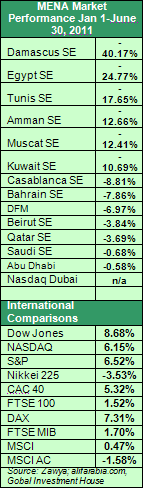
However, Kuwait, the fourth largest market in the region in terms of market cap fell nearly 11% in the year. Analysts don't expect a major improvement in the Kuwaiti market, but a rising tide in the region could lift the Kuwaiti index as well over the next six months.
Muscat Stock Market was the worst performing Gulf market, as domestic turmoil dampened investor sentiment. While MSM's PE ratio is the lowest in the region, there are a few catalysts for an upside, save a bump in oil prices.
As the markets say goodbye to the first half of the year, the markets may also get a fillip on the back of robust corporate earnings in the second quarter.
"We expect earnings growth to accelerate to 31% Y-o-Y and 16% Q-o-Q in 2Q2011, although a strong turnaround in Aldar's earnings in 2Q2011 flatters aggregate earnings growth," says EFG-Hermes in a note.
"Excluding Aldar, 2Q2011 earnings are expected to rise 20% Y-o-Y (an improvement from 12% Y-o-Y in 1Q2011), but growth should decelerate to 9% Q-o-Q from 14% Q-o-Q in 1Q2011."
© alifarabia.com 2011