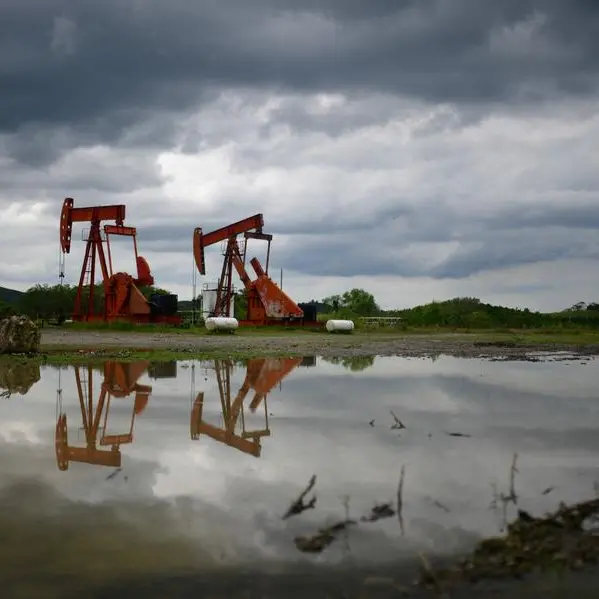
The oil and gas sector is adjusting to a shifting industrial landscape as new reserves become more difficult to access due to their challenging locations. In addition, rising global population and increased urbanization are likely to prompt an ever-growing need for fossil fuels.
Over the past years, the world saw how global uncertainties affected the oil and gas sector, with energy demand and supply subjected to numerous challenges from fluctuating oil prices and changing government policies to fiscal growth rate and consumer behavior.
Managing this tug of war between energy supply and demand will perhaps be one of the greatest predicaments facing oil-producing nations and major petroleum companies going forward.
As global energy demand is anticipated to grow twofold by 2050, Dr. John Barry, Vice-President for Shell Corporation's operations in Abu Dhabi, Kuwait, and Syria, said technological advancement and innovative methods are essential in order to optimize upstream and downstream strategies.
Barry, who has held several key positions at the Dutch oil giant since 1983, also believes that investing in research and development (R&D) is pivotal in staying ahead of the curve. The oil price boom of the past five years, he added, has made it financially possible for industry players to invest in technologies that will enhance hydrocarbon recovery processes.
Zawya spoke exclusively to the Shell executive to find out what new approaches their company has been adopting to break through the barriers.
What do you see are the opportunities currently available to oil and gas companies?
With the rising global challenge of meeting future energy demands, our world is headed towards what we at Shell describe as a period of significant stress between energy supply and demand. This moment is happening now and is expected to last until 2050.
At the same time, people worldwide are seeing a rapid pace of economic development and an accelerated shift in influence from West to East. Hundreds of millions of people are emerging from poverty as wealth levels rise, and with that, the global population has also seen an increase of more than 200,000 people every day. That means the world will be adding the equivalent of a city of one million people every week for the next 30 years.
Without access to energy, many of the modern amenities we have today such as travel, food, electricity and even smart phones might not exist. We will have to continue working harder and innovate more in order to keep energy supplies growing as fast as energy demand.
When assessing the current state of MENA's oil and gas sector, what measures should be adopted to overcome the challenges that confront the integration of upstream and downstream in new projects?
The integration process between upstream and downstream processes depends highly on striking the right balance and synergies between the 'source' and the 'consumer'. Shell has been able to successfully manage the integration of its R&D programs throughout its supply chain.
For instance, our Qatar Pearl GTL project is a prime example of successful integration. Upstream, the project produces and processes around 1.6 billion cubic feet a day of wellhead gas from three automated offshore platforms. Whereas with downstream, the onshore gas-processing facilities treat the sour and rich wellhead gas to remove contaminants such as metals and sulfur, and further extract natural gas liquids, including ethane for petrochemical processes, liquefied petroleum gas (LPG) for domestic heating and cooking and condensates as a feedstock for refineries.
How can oil companies monetize reserves, especially new hydrocarbon projects?
As oil and gas resources become more difficult to access due to their remote locations, plus the fact that they may be found miles beneath the sea or in challenging reservoir formations, we at Shell have been working to identify and help monetize new sources of energy, especially natural gas.
We have recently been awarded the contract for a milestone project, the development of the Bab sour gas field in Abu Dhabi. Sour gas fields pose a significant technical challenge as the gas contains high contents of toxic hydrogen sulfide and are located deep underground in a high pressure and high temperature environment, requiring the application of advanced drilling and processing technology.
Over the last 50 years, Shell has built a strong capability in treating contaminated natural gas streams. All in all, Shell has developed or licensed the technology for more than 1,200 contaminated gas-processing plants globally.
Innovative approaches will also have to be applied to prolong the life of existing fields. As a result, advanced approaches to field management can make a difference to extending the life of mature resources. Enhanced oil recovery (EOR) technologies could add 300 billion barrels to the world's total recovery from mature fields. For example, Petroleum Development Oman (PDO) has several similar advanced projects under way in partnership with Shell.
How can increased spending on human capital development help governments across the region achieve sustainable economic growth?
Nurturing human talent is very important to sustain a competitive advantage. To realize this, we have built a truly global approach on acquiring, developing and deploying our talents.
In Abu Dhabi, our team at Abu Dhabi Company for Onshore Oil Operations (ADCO) has recently delivered a successful well engineering management training program, using the Shell Round 1 and 2 courses.
We are likewise committed to contributing towards the development of a knowledge-based economy in the local markets we work in. We believe that engineers and scientists should be at the forefront of any technological advancement, which will be crucial in meeting the rising energy demand and reducing the industry's carbon footprint.
How many patents have Shell registered to date and what is your strategy in integrating R&D with supply chain management?
Shell has over 20,000 patents that span across all research focus areas of the oil and gas sector - from reservoir exploration to the individual downstream products that we offer such as Shell Helix engine oil and Shell Rimula lubricants, among others, which are market leaders in this region.
Our company has spent over 40 years researching gas-to-liquids (GTL) technology, and we have developed our proprietary technology over the past decades. We built the world's first commercial GTL plant in Bintulu, Malaysia in 1993. Since then, we have continued to build on our expertise with over 3,500 patents along the natural GTL process. In 2011, we started production at the world's largest GTL plant called Pearl, located in the Ras Laffan area in Qatar.
The natural GTL technology makes it possible to use natural gas, rather than crude oil, as the raw material to produce a range of oil products. These include cleaner fuels for cars, planes, and materials that go into making chemicals and lubricants. Through our GTL processes, we are able to produce gasoil, normal paraffin, kerosene, base oils, and naphtha.
We have also successfully integrated our upstream, midstream and downstream businesses. One of the best examples is our transformative innovation in catalyst technology, which resulted to the integration of our downstream R&D efforts.
What is your outlook for the oil and gas sector in the foreseeable future?
We are in the midst of a decisive period with respect to energy, where global energy demand is expected to double by 2050. In order to improve our understanding of the world's energy system in an era of shifting global dynamics, we have been commissioning every year for the past 40 years a group of economic, political and energy experts to explore different views of how the future might unfold - we dubbed this the 'New Lens Scenarios'.
In the first scenario, called 'Mountains', we found that intelligent urban planning in the world's rapidly growing cities will contribute to the transformation of the global transport system over the next 50 years. This will occur as smart cities provide the infrastructure for a car fleet powered mainly by electricity, hydrogen and natural gas.
In the second scenario, called 'Oceans', increased oil prices make it economically viable to apply enhanced recovery technologies more widely to develop resources trapped in technically complex and challenging locations. Oil supply and demand will continue to grow during the next two decades before reaching a plateau in the 2040s, when a lack of policy progress in key areas of carbon pricing and compact city development fails to challenge the pre-eminence of the internal combustion engine. The second scenario concludes that by the middle of this century, liquid fuels will still deliver 70% of road passenger kilometers.
We at Shell believe that achieving energy sustainability will be challenging, but nevertheless possible with the visionary approach of many regional governments that recognize the need to diversify their energy mix.
The right technology, innovation and R&D investments are all fundamental to Shell's vision. With our ongoing commitment to partner with the region's governments, we are confident that together we can effectively respond to this challenge and shape an optimum scenario for the future.
© Zawya 2013