Tired of western dominance in global financial circles, the key emerging economies are forging a new parallel path by discussing plans for a new development bank.
Leaders of Brazil, Russia, China and India are in South Africa for the fifth BRICS summit in a new effort to bring their diverse economies closer together.
While the countries eventually failed to agree on funding and location of the bank, it nevertheless highlights the frustration among rising emerging economies with financial institutions such as the World Bank and the International Monetary Fund.
The groups plan to persist with the bank idea and reconvene during the G20 summit in April.
The five emerging economies have been leading global growth, as western economies have stumbled over the past decade.
BRIC economies have grown nearly 8% over the past decade compared with the paltry 1.5% GDP growth of developed markets, and now account for a fifth of the global GDP and 40% of the world's population.
Indeed, BRIC economies are set to grow at 6.9% over the next decade, compared with the 2.2% in developed markets, according to Goldman Sachs, which originally coined the term BRIC.
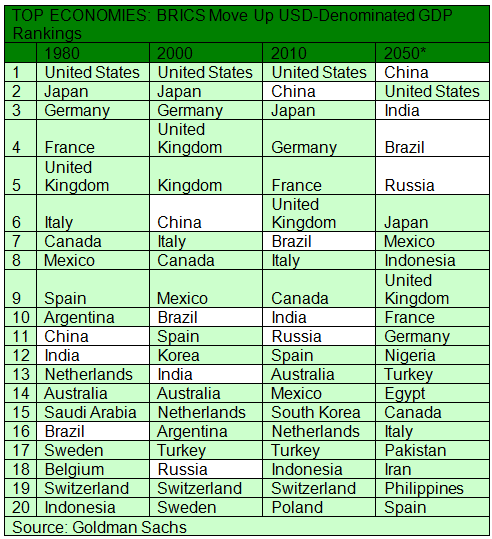
The rapid economic progress means that at some point before the first half of the century, China will push the United States to second place and emerge as the world's largest economy. India is expected to be third largest, while Brazil and Russia will make up the five largest economies in the world, according to Goldman Sachs' forecast.
Synergy in diversity
The BRICS is no doubt an odd group. Dispersed geographically, the economies have little in common and face varied challenges. But there are also strong synergies. Russia is the world's largest producer of oil and China recently emerged as the world's largest consumer of crude.
Before coming to South Africa, Chinese President Xi Jinping visited Moscow to strike a number of oil and gas deals with Russia.
Russia's Gazprom and China National Petroleum Company (CNPC) signed a 30-year memorandum to supply 38 billion cubic meters (bcm) to 60bcm of natural gas from Eastern Siberian fields from 2018.
"We believe that diversification of Russian oil and gas exports to the Asia-Pacific region will further strengthen Russia's position as a key energy supplier in the region," noted Fitch Ratings.
Russian companies are making strong inroads in China. Earlier in the year, Gazprom agreed to construct a three-train, 15 million tons per annum LNG plant in the Russian Far East near Vladivostok, with the first train to be commissioned in 2018, with plans to supply LNG from there to Asian markets.
Meanwhile Rosneft, another major Russian oil and gas company, struck a deal with China to double its oil shipments from 15mtpa to as much as 31mtpa in exchange for a pre-payment, and agreed on a number of joint projects in exploration, refining and chemicals production with China National Petroleum Company and Sinopec.
Rosneft also raised an additional USD 2-billion loan from the China Development Bank under the existing 25-year agreement signed in 2009.
China Development Bank also provided a USD 5-billion loan to South Africa's state-owned ports and rail operator Transnet, which would help facilitate trade with China and other BRIC states.
"China is South Africa's biggest trading partner and a significant investor in the South African economy," said South African President Jacob Zuma in a speech to welcome the Chinese president.
"In 2012, exports from South Africa to China amounted to [ZAR 89 billion], while imports from China to South Africa totaled [ZAR 112 billion]. Total trade stood at [ZAR 201 billion], according to figures from the SA Revenue Service."
Meanwhile, Brazil and China have agreed to swap USD 30 billion in each other currencies in the event of a banking crisis.
Heavyweight China
China is the group's outsized member and unofficial leader of the group. Critics argue that the group has little meaning and has not served its purpose.
A recent Atlantic article highlights the differences: "The brute fact is that China has continued growing more than twice as fast as other members of this club.... Given this divergence, it is more appropriate to consider China separately from Russia, India, Brazil and South Africa, which, if an acronym is called for, can be called: 'RIBS'."
However, the article seems to miss the point.
The North American Free Trade Agreement (NAFTA) is a trading bloc of one giant economy (the United States), with two relatively small ones (Canada and Mexico).
The European Union contains powerhouse Germany along with minnow Cyprus.
Meanwhile, the 11-member TransPacific Partnership that president Barack Obama is aggressively pushing for, includes free trading agreements with the miniscule economies of Brunei and Peru.
The BRIC concept is evolving and has already moved from its original frame of reference by including South Africa.
This year, the group also invited Angola to this year's summit, and there is some talk of Nigeria entering the group at some stage.
Perhaps, at some point, Gulf states should consider joining the group, to create a larger market for emerging economies, moving from the US currency and forging new alliances.
The BRIC group is also using its financial resources to expand trade in impoverished African states that had been abandoned by western powers decades ago.
While there has been some criticism of BRICS replacing the West as Africa's new colonial powers, the group points to massive investments being poured into the continent's infrastructure by the members.
China and its partner have played a key role in improving the infrastructure of many countries and have lent support to countries like Botswana, Kenya, Tanzania and Gabon. In return, they have befitted to from access to Africa's resource riches.
As president Zuma said in his speech, the BRICS are seeking "to find the means towards a more equitable balance of trade."
Indeed, the BRIC remains a work in progress, and certainly a project worth pursuing. Perhaps it would serve more purpose if it abandon its slightly laborious acronym and become a platform for like-minded emerging economies.
© alifarabia.com 2013