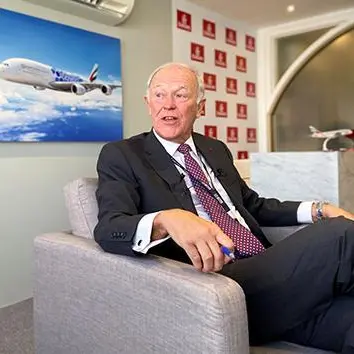
Ericsson's new regional VP Khaled Rabie aims to take connectivity to the next level
Every era of human history has been defined in part by the appearance of a new technology that changes the way people live, learn and work, pushing the boundaries of human potential to unexpected levels.
Yet how often did innovators of past eras -- whether the scribes of Pharaonic Egypt or the inventor of the printing press -- realize they were introducing, or at least partaking, in a phenomenon that historians would look back on as the next step in humanity's advancement?
This mental exercise is certainly much easier in our own age. While our ancient ancestors often dealt with history-altering developments over the course of centuries, the 21st century is pivoting on an industry that produces dramatic change in our daily lives on the scale of years, if not days. The impact of the information and communication technology (ICT) industry leaves little doubt that we are living in a crucial time of innovation and endless possibilities.
This is perhaps what lends such a sense of excitement to the industry. Leaders of the ICT industry can easily grasp the significance of their vocation in the grand scheme of things. An opportunity to participate in defining an era is what inspired Khaled Rabie, in December 2011, to take up his current position as Vice President of Public and Economic Affairs at Ericsson Egypt and North East Africa.
Ericsson, based in Sweden, is a world-leading provider of ICT equipment and services to over 1,000 mobile and fixed networks in more than 180 countries. More than 40% of the world's mobile traffic passes through Ericsson networks.
Rabie's appointment to this global ICT player is the culmination of over two decades of participating in ICT projects around the globe. He began his career as an engineer before launching into sales and marketing at Siemens in 1993 and serving as country director at Nokia Siemens Networks.
In his current position, Rabie brings extensive and diverse international experience to Ericsson, in addition to a sense of excitement for the ICT industry's future and a historical perspective that fully grasps the industry's significance.
Learning from the past
With a grin, Rabie describes Dire Straits' "East Bound Train," a 1980s folk rock song, as a succinct expression of the romantic and adventurous spirit of another exciting era of innovation -- the age of railroads.
Rabie sees the 19th century development of railway lines as the most apt metaphor for the significance and endless possibilities of the ICT industry in our day. Railroads were a source of communication, transportation and commercial trade that proved an essential element in pushing the industrial age forward.
"We say in Arabic "qitar al-tanmiya" which means 'the train of development'. [...] That phrase came from the industrial revolution," explains Rabie. "When the industrial revolution started in Europe, the railways [...] flourished. It was known back then that to develop economically, socially, in any area, you needed to be connected to a railway line."
The same is true today of the ICT industry, says Rabie. Just as railroads served as an engine of development during the industrial age, ICT today is a driving force in all economic sectors. The development of any country now depends on its ability to tap into this global network of information.
This is the fundamental idea behind Ericsson's concept of the "Networked Society." The concept envisions a more connected world with the aim of producing solutions to the world's greatest challenges, such as climate change, sustainability and the availability of education and healthcare.
The path to Ericsson
Rabie's love for the innovative began during his days as an undergraduate at Cairo University Faculty of Engineering. When the time came to choose a specialization, Rabie looked for a field that offered innovation and growth. Civil engineering was quickly eliminated -- "Building bridges has been there for ages," -- as was architectural engineering -- "Who can compete with the pharaohs?"
His choices quickly boiled down to medical and ICT engineering. As a medical engineering trainee, Rabie was called in to fix a defective life support machine in an intensive care unit. The catch: if the repairs weren't finished in time, an open heart surgery patient would die.
"To be honest, I couldn't take that kind of stress," recalls Rabie. "So when I had to choose between ICT and medical engineering, I chose ICT."
Upon graduation in 1991, Rabie joined Munich-based electronics and electrical engineering company Seimens as a service engineer. He contributed to several telecom projects in the Suez Canal area and in Upper Egypt. Over the course of three years as an engineer, Rabie waited for an opportunity to move into sales and marketing.
In 1993, he was finally able to make his voice heard at the Siemens headquarters in Munich. He spent the next several years on the company's sales and marketing team, flying to Munich to develop strategies and projects and back to Cairo to implement them. In 1997, Siemens decided to open a full-fledged sales and marketing department in Cairo, in which Rabie held the position of Sales Manager for Switching Department.
During his time at Siemens, Rabie gained valuable international experience that took him to Dubai for five years as a senior sales account manager, handling business for UAE-based mobile provider, Etisalat. In Pakistan, he played a vital role in a major telecom sector acquisition. This was followed by a brief period developing telecom infrastructure in Iraq in the run-up to the 2003 US invasion.
In 2003, Rabie returned to Cairo as Vice President for Siemens Egypt. In 2007, Nokia Networks and Siemens Communication merged to create Nokia Siemens Networks (NSN). Rabie was appointed country director of the new company, where he served until taking his current position at Ericsson.
Connecting for the future
After a distinguished international career, moving to Ericsson was the natural next step in Rabie's career path. He credits Ericsson's dominant market position, which has been number one worldwide in the telecom vendor field for the last ten years, as a main motivation for taking on the job.
For someone with such a strong historical perspective, being part of a company with a proud historical legacy was a perfect fit. More importantly, Rabie also shares with Ericsson an ambitious vision for the future. The company was established in 1878 as a telegraph and telephone manufacturer and over the decades continued to expand in new regions and technologies. The company remained a global leader in ICT for over a century, today rolling out 4G network technology.
"Being at Ericsson gives me the advantage of having a company that supports my vision, having this excellent thought leadership, seeing the world connected," says Rabie. "The thought leadership gives me that privilege, the support, to deliver what I wish to this country."
The launch of the Networked Society initiative in 2011 was the crystallization of this vision. The initiative will begin with studies to analyze the global development of the ICT industry.
"There will be a study for social impact. The study gives a picture of how telecommunication affects the triple bottom line: economic, social and environmental," explains Rabie. "Out of that big picture, there will be two other individual studies only on social impact and economic impact, more in depth."
The second component of the Networked Society concept is working to connect 50 billion devices worldwide to telecommunication networks by 2020.
"We're not just talking about people," says Rabie. "Things will become connected: machine to machine, cars to traffic, oil pipeline to the operation room, telemetering to electricity distribution."
Rabie's railroad analogy may seem quaint, but as both the industrial and post-industrial age prove, connection is everything, and those societies that connect will reap enormous benefits.
"Statistical information [shows] that on average, globally a 10% increase in broadband penetration earns 1% growth in GDP," says Rabie. "We've seen another statistic that says for every 10,000 subscribers in broadband, 80 new jobs are created. So there are a lot of social and economic benefits to using and developing the ICT sector. It not only develops the ICT sector itself, it also develops other sectors as well."
The recent development of telemetering is one of many practical examples Rabie uses to explain the role ICT can play in driving other industries. Telemetering is a concept currently implemented in several countries. Rather than having an employee make rounds counting electricity consumption on meters, the information is collected automatically and sent via a fixed or mobile line to the operation room.
"The simple way to look at it is that things are automated, so you don't have to send someone to read it, but that's not all there is to it," says Rabie. "The reality is, when you collect [information from] those meters manually, the gathering of information takes time [...] until you collect all the data, put it together in an operation room and see the consumption of that geographical area."
The application of telemetering represents the many advantages that connectivity offers to a wide range of industries and ICT's potential for driving economic development. "At any given time you can see the consumption and the behavior of a certain geographical area. It helps to carry out proper planning and [gather] statistical information," Rabie explains. "If you see on a country map which area of the country has a peak before which area - maybe there is a gap of one hour between two peaks - then you distribute your power accordingly. [...] This saves a lot of money, it saves a lot of energy, it saves a lot of CO2 emissions."
With the rolling blackouts of past summers, telemetering is a potent example of ICT's potential to contribute to the myriad developmental challenges of Egypt.
This is the mission that Rabie is pursuing not only as a regional Vice President of Ericsson, but also as a member of the ICT Industry Committee, a consultative body operating under the National Telecommunications Regulatory Committee (NTRA). In this position, Rabie is working closely with the government and other stakeholders to advance telecommunications services in Egypt, most notably through the Ministry of Information and Communication Technology's E-Misr initiative that aims to develop the nation's infrastructure.
"I remember four or five years ago, Egypt was not on the map at all," says Rabie, expressing his hope that Egypt will one day take a leading global role in the ICT industry. "Two to three years ago, Egypt started to appear in reports, to gain better rankings year after year for multiple reasons -- the ICT infrastructure, the bandwidth availability, the availability of educated people, graduates, the availability of languages and proximity to key regions."
Rabie's hopes reflect a sense of enthusiasm across the industry. With booming internet and mobile communication use, and what Rabie sees as a pro-active stance from the government, it is no longer unthinkable that Egypt may one day be an essential player in an industry that is rapidly changing the world.
"All the elements are available," concludes Rabie. "We need only to gear them up and let them go."
© Business Today Egypt 2012