In a rare victory for Liberals in North Africa, interim Prime Minister Mahmoud Jibril's party scored a resounding victory over the country's Muslim Brotherhood party.
Recent elections in Tunisia, Morocco and Egypt have brought Islamic parties to elected office, but Libyans' political inclinations have turned out to be quite different.
Unlike in Egypt, where Presidential candidate Ahmed Shafik was rejected for his close ties to the past regime, the link to the past worked in Mr. Jibril's favour who served as the head of the National Planning Council of Libya and the National Economic Development Board of Libya from 2007 to early 2011. During his time in the Gaddafi government, Mr. Jibril was associated with the privatization program and economic liberalization effort championed by the late dictator's notorious son Saif Gaddafi.
All things considered, Libyans should cherish the election milestone. Libyans had been denied the right to choose their leader for decades, and they came in the millions to select from more than 3,700 that stood for a chance to be part of the 200-member assembly. Libya's Alliance of National Forces Coalition of 60 parties, which could only compete for 80 seats, have reportedly won 60% of the votes according to early media dispatches.
Not that the elections were without tensions. A number of local leaders were upset that the eastern region was allocated 60 seats in the constituent assembly while the more populous western region was awarded 100. Armed militants shut down three major export terminals with a combined capacity of 690,000 barrels per day for 48 hours to signal their displeasure with the regional composition of the constituent assembly.
"Indeed, increasing insecurity and disruptions have been overshadowing Libya's speedy return to pre-war oil production over the past few months, delaying much-needed foreign expertise and investment, as well as threatening output," noted Barclays analysts in a report. "A lot of the European oil companies are slowly returning, but remain sceptical and continue to highlight security as their biggest concern."
The election of western-educated Mr. Jibril as the head of the state would soothe western investors' nerves. Even before the elections, the International Monetary Fund expected Libya to post a jaw-dropping 116.6% growth in real GDP in 2012, and also post strong 16.5% and 13.2% growths in the next two years.
WHAT'S NEXT, POLITICALY SPEAKING?
It is interesting to note that Mr. Jibril has not lost his popularity among Libyans during his interim prime minister even though unemployment stands at 26%. But that may not last, as the citizens now expect greater improvement very quickly.
For all its promise, the country remains on a knife-edge given the fragile alliances that holds the peace together:
Libya is home to hundreds of armed militia groups that do not answer to a central authority and clash routinely - if they feel they are disenfranchised or overlooked in the new political order, they could stir trouble.
As the IMF noted: "Libya is at a historic juncture and the authorities face the twin challenges of stabilizing the economy and responding to the aspirations of the revolution."
But there are a few important housekeeping rules to adhere to before the country embark on both fronts.
"The immediate concern will be to finalise the counting and form a government, with present indications suggesting Jibril will be appointed Prime Minister," said Jonathan Terry, Senior Analyst at Maplecroft.
Libya remains divided along tribal and regional lines and bringing the various factions together would be a great challenge for the ruling party.
More importantly, there are questions marks whether Mr Jibril can remain in charge for long.
"Hopes that a new Libyan government will be open to foreign business looks more certain under Jibril, but it is unclear what role he can play in the government beyond 2013 as he cannot stand for election under NTC rules," said Maplecroft's Terry. "Indeed, it should not be forgotten that the new government formed in the coming weeks will only serve as an interim authority, with full legislative elections not expected until 2013."
OIL-DRIVEN GROWTH
The IMF expects the country's crude oil production should reach pre-conflict levels, while reconstruction expenditure and the release of pent up private demand should facilitate an improvement in non-hydrocarbon sectors. 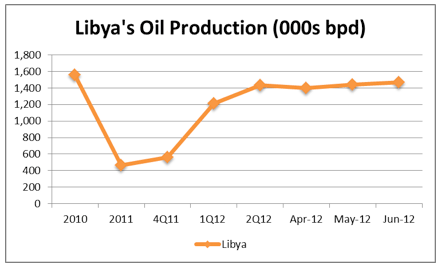
Source: OPEC
"Increased hydrocarbon exports will lead to a fiscal surplus of 14.2% of GDP and increase the current account surplus to 21.9%," said the IMF. "The normalization of imports will continue to contain consumer price inflation at 10%, despite the upward pressure on prices arising from supply bottlenecks in housing and transportation. Nevertheless, a significant reduction in unemployment, which is largely structural-- estimated at 26% as of end-2010 -- will not occur as a result of a return to the pre-conflict status quo."
OPEC data shows the country 1.47 million barrels per day in June 2012, compared to 1.56 million on average in 2010, and is set to eclipse that figure soon. Not surprisingly, the IMF expects oil GDP to rise a staggering 205% during the year.
But this could be marred by frequent interruptions to crude output, such as the crude production that was shut by the militia in July, but has since reopened.
"Increasing insecurity and disruptions have been overshadowing Libya's speedy return to pre-war oil production over the past few months, delaying much-needed foreign expertise and investment, as well as threatening output. A lot of the European oil companies are slowly returning, but remain sceptical and continue to highlight security as their biggest concern," notes Barclays.
While Royadl Dutch Shell has abandoned its project in Libya, citing poor prospects, BP has lifted its 'force majeure' and returning to Libya. The company has five offshore and 12 onshore exploration commitments which were interrupted due to the civil war in Libya last year. The British oil major's return would be a welcome vote of confidence in the Libyan hydrocarbons sector.
Other oil giants Statoil and Total also recently met the country's oil executives and are considering more development in the country.
Oil production, however, is only part of the equation.
"Over the medium term, Libya needs to address issues including capacity building and improving the quality of education, rebuilding infrastructure, financial market development, reducing hydrocarbon dependence, and putting in place an efficient social safety net," said the IMF in its report.
"It will also need to set up a governance framework linked to transparency and accountability that would promote private sector-led development, job creation, and inclusive growth."
Clearly, a long road to reform. But a journey, nevertheless, well begun.
© alifarabia.com 2012