The region is forecast to invest $525-billion in the energy sector, but funding concerns could upset the ambitious investment programmes
The Arab Petroleum Investment Corporation (Apicorp) expects MENA energy capital investment to reach $525-billion over the next five years.
But the Dammam-based lender estimates that the figure is at least $90-billion short of the 'investment potential'. The company examined nearly 200 energy projects planned and announced in the public and private sectors.
While oil projects are expected to gain momentum due to the high price of crude, gas projects may be delayed due to a glut in global supplies.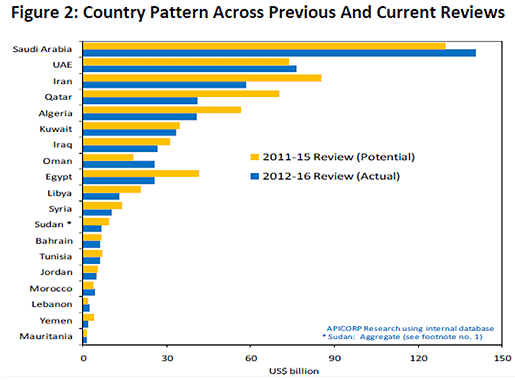
"For natural gas, however, the option to wait may still have value for project sponsors as they continue facing higher market uncertainty," notes Apicorp senior consultant Ali Aissaoui.
"Gas prices, which have greatly deviated from oil parity, are expected to keep diverging between markets: $4‐5/MBtu in fully liberalized markets with abundant domestic supplies to $12‐15/MBtu in markets relying on imports under traditional long term contracts."
Not surprisingly, Saudi Arabia leads the ranking with $141-billion in energy projects under way, with the UAE a distant second with $76-billion projects.
Iran is third with $48 billion, and Qatar's moratorium in its North Field gas developments means the gas-rich country will only see investment of $48-billion in its energy sector over the five-year period.
However, Kuwait and Iraq - which offer tremendous potential in their natural resources - will continue to suffer from under-investment.
"In Kuwait the problem seems to be one of policy paralysis induced by indecisive politics. As a result, major components of the upstream program and key downstream projects such as the giant al‐Zour refinery are still to be decided," says Aissaoui.
"In Iraq there seems to be no major disagreement about the vital need to achieve the full development of the oil and gas sectors. However, for the commitment to be credible, the federal government needs to pass a long‐awaited package of hydrocarbon legislation and provide durable solutions to recurring security threats and logistic complications."
Meanwhile, energy investments in countries like Egypt, Libya, Syria, Tunisia, Yemen and Bahrain is expected to suffer on account of the domestic unrest faced by each of these nations.
Of the $525bn capital requirements in MENA region for the period 2012‐16, the oil value chain accounts for 42%, the gas value chain for 34% and the remaining 24% represent the oil and gas fuelled power generation sector.
The power/water sector has remained a key, steady driver of investment for MENA energy sector, but clearly has not moved fast enough given the chronic shortages in many countries. To catch up with unmet potential demand, this sector needs massive capital requirements of some $126bn whose funding will be most challenging, according to Apicorp estimates.
Funding worries
But there are challenges ahead, as deteriorating global economy could put pressure on funding availability for projects.
Raising high amounts of debt in a context of a collapsing loan market and persistently high cost of borrowing will be hardly possible, notes the bank, referring to the global economic downturn.
"Project sponsors will continue to face many of the same challenges, i.e. cost uncertainty, feedstock availability and fund accessibility, with the latter becoming more critical than any time before," says Apicorp.
As long as average Opec crude prices remains above $90 billion, many countries can make for the funding shortfall.
"But the resulting shortfall could be even larger if MENA public investment funds, which have stepped up their involvement in the local loan market in recent years, are denied support by governments now confronted with more competing social demands for public funds," concludes Apicorp.
Constrained supplies
Paradoxically, funding constraints will ensure that oil prices remain high despite slowing demand, especially in OECD countries.
Prices have remained high due to loss of Libyan supply and an acute awareness by oil traders that much of the world is pumping oil at near capacity - with the exception of Saudi Arabia and a few other Gulf countries.
Barclays Capital notes that while global oil demand growth has slowed from last year's high base yet remains healthy by historical standards.
"Our analysis suggests that if global GDP growth was cut by half (to about 2% year-on-year), global oil demand growth could be a mere 0.4-0.5 mb/d and that in order to see negative oil demand growth, global GDP would need to fall very markedly to about 1% year-on-year (with almost all growth coming from emerging economies and the OECD in recession)."
Not surprisingly, most analysts, including Barclays Capital, expect Brent crude to hover around $110-121 next year, as global economy stages a recovery of sorts.
This positive outlook could well ensure that oil projects could find financing even in a tough economic environment.
© alifarabia.com 2011