09 July 2012
The global economic mood remains sombre, and analysts are looking at inventive ways to describe the real horrors facing the global economy. From 'Omnishambles' to 'fiscal cliffs' to 'Grexit', the global economic tremors are inspiring new phraseology and terms, as observers struggle to explain the depth of the crisis.
Societe Generale economist Albert Edwards calls the global crisis as the 'ice age'.
"Expect the S&P500 to decline decisively below its March 2009, 666 intra-day low. All hope will be crushed," noted the famously bearish analyst. "Our Ice Age thesis has been our roadmap for the macro events that we have witnessed over the last 15 years. Many have laughed at our views. But much to the chagrin of the cohorts of equity bulls in the industry, their beloved and supposedly 'cheap' equities have become cheaper and cheaper. They will get cheaper still before this is over. Mutatis mutandis for bond bears as yields continue to slide."
Nouriel Roubini, another sharp, well-known Wall Street analyst, believes dark, lowering financial and economic clouds are rolling in from every direction: the eurozone, the United States, China, and elsewhere. Indeed, the global economy in 2013 could be a very difficult environment in which to find shelter.
"Finally, long-simmering tensions in the Middle East between Israel and the US on one side and Iran on the other on the issue of nuclear proliferation could reach a boil by 2013," wrote Mr Roubini in a June column.
"The current negotiations are likely to fail, and even tightened sanctions may not stop Iran from trying to build nuclear weapons. With the US and Israel unwilling to accept containment of a nuclear Iran by deterrence, a military confrontation in 2013 would lead to a massive oil price spike and global recession."
HSBC analyst Karen Ward says the mood in financial markets is 'glum' - and there are few signs of solutions to some of the deepest problems still confronting policymakers, five years after the crisis began. "It all looks like a colossal muddle."
In a similar vein, Deutsche Bank has identified the four key risks facing the global economy.
RISK 1: The euro crisis: Debt, sweat and tears
The latest Euro summit pleasantly surprised markets but not enough to resolve the crisis.
Europe's four 'wise men' -- European Union President van Rompuy, Eurogroup President Juncker, European Central Bank President Draghi, and EU Commission President Barroso -- apparently presented a report to the participants charting a strategy for "a genuine economic and monetary union". The report contained a "vision" of an European Monetary Union.
However, the final summit communiqué did not mention that report, suggesting deep divisions between European leaders.
If the stalemate continues, there could be two possible outcomes, says Deutsche Bank.
First, economic reform in troubled countries could lead to market confidence and make their public debt sustainable.
"Whether or not this outcome will materialise depends mainly on the willingness of the peoples and the ability of the governments of Italy and Spain to undertake the necessary economic and financial reforms," notes Peter Hooper, an analyst at Deutsche Bank.
Second, failure to implement reforms in troubled countries leads to a complete loss of market access, forcing the European Central Bank to "act as a lender of last resort on a very large scale to prevent a global financial catastrophe."
Eventually this could lead to a division of EMU countries into northern 'Nordic' and southern 'Latin' states.
RISK 2: U.S. Fiscal Risk Heats Up
The United States is in danger of facing yet another serious downgrade of its sovereign debt, if it does not resolve its fiscal crisis.
This event could be triggered if Congress votes to delay the bulk of the so-called fiscal cliff. The US budget deficit is projected to drop by about 5% of GDP in 2013 as various past tax cuts and spending programs are scheduled to lapse. If allowed to go through, most analysts, ourselves included, agree that this shock, the so called 'fiscal cliff' would put the US economy back in recession next year.
"To make it though this fiscal minefield over the next nine months without a significant disruption to financial market will take a great deal of goodwill and cooperative spirit among US political leaders," says Mr. Hooper.
With a heated election year under way and the Democrats and republicans divided on ideological lines, room for compromise will be hard to find.
"The U.S. could very well be on the way to experiencing the pain that Europe has felt when markets begin to drive policy."
Barclays Capital analysts disagree, arguing that U.S. recession fears are overdone.
The British bank believes the last recession was a reaction to the excessive optimism about housing prices that prevailed in the prior expansion. Similarly, the 2001 recession followed a period of excessive optimism about the future of the technology sector amid euphoria about the internet and its possibilities.
"According to this reasoning, the economy is at its most vulnerable when expectations are at their most optimistic," says Dean Maki, analyst at BarCap. "We believe there is currently little excessive optimism in the U.S. economy."
Risk 3: Emerging Markets Unwilling to Take The Lead
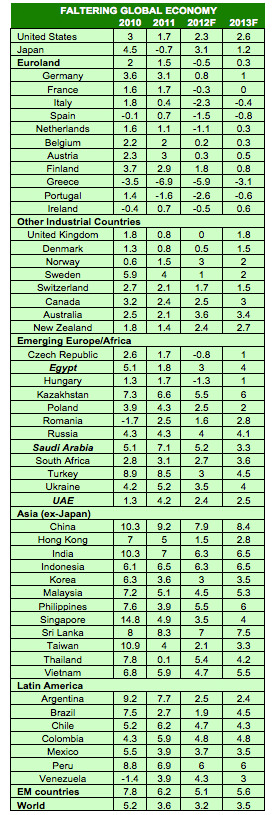
The global economy has leaned heavily on emerging economies to keep its head above water, but it seems unclear whether they can continue to pick up the slack.
While the smaller emerging economies, which depend heavily on exports to developed economies, have been lethargic, even the large BRIC economies, for which exports are not the primary source of growth impulse, have seen growth slowing down over the past year or two.
But it seems that most emerging economies have little headroom to stimulate the economies, as they are fighting high inflation and high public debt.
Meanwhile, even economies such as South Korea and China that have little depth don't appear to have the appetite to accumulate more debt.
The German bank thinks that the emerging market's policy stance is largely one of waiting for Europe and the U.S. to sort themselves out and return to their role as the primary drivers of global growth.
"Put another way, it appears it will take a much more significant deterioration in the EU or US growth outlook for emerging market policymakers to act forcefully to stimulate demand in their economies."
HSBC notes that another key problem in emerging markets, who have become the world's biggest savers are unwilling or unable to step in to fill the void left by the faltering EU nations. The only way to return to the pre-crisis world growth sustainably is for an amicable resolution to global imbalances, notes HSBC analyst Karen Ward.
"This involves former surplus nations starting to pull their weight for the collective good of world demand. We're not blaming China. Whether you consider current account surpluses or the behaviour of domestic demand, China is the one large surplus nation that is changing its ways. The same cannot be said for Germany, Japan, or particularly in recent years, the OPEC oil exporters, whose surpluses have grown dramatically."
Source: Zawya.com
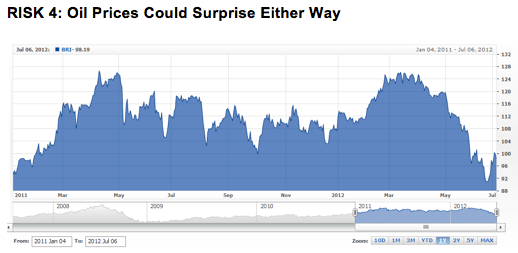
Deutsche Bank appears to be hedging its bets here, as it believes crude prices have the potential of surprising on either the upside or the downside.
Oil prices may have cooled off from their $120-a-barrel highs, but they continue to remain above historical levels. However, geopolitical issues will continue to ensure crude prices factor in a war premium.
These upsides may be offset by lower global economic growth, which could put prices under pressure.
"Given substantial increases in U.S. shale oil and gas production potential and possibly factors favouring continued strong Saudi oil production, the likelihood of a surprise to the downside and a further reduction of our oil price forecast seems greater than the opposite outcome."
CONCLUSION
The gloom surrounding the global economy is worrying as most analysts don't appear to see any light at the end of the tunnel.
Each of the four risks outlined by Deutsche Bank could well shock the global economy into a recession. For now, the bearish economists seem to be winning the day with their arguments evoking Armageddon.
The most worrying aspect of it all is that the fate of the global economy is in the hands of politicians - especially those in the European Union and the United States. That has hardly inspired confidence among investors, given the current track-record of elected officials in the developed world.
"A huge amount is at stake - we believe the impact of a possible eurozone break-up would dwarf the 2009 global recession and rival the great depression of the 1930s," notes Mr. Ward. "But economists must be humble about their ability to quantify the scale of any fallout - as we learned following the collapse of Lehman Bros when the IMF predicted global growth of +3% for 2009. The actual outturn was nearer -3%."
The global economic mood remains sombre, and analysts are looking at inventive ways to describe the real horrors facing the global economy. From 'Omnishambles' to 'fiscal cliffs' to 'Grexit', the global economic tremors are inspiring new phraseology and terms, as observers struggle to explain the depth of the crisis.
Societe Generale economist Albert Edwards calls the global crisis as the 'ice age'.
"Expect the S&P500 to decline decisively below its March 2009, 666 intra-day low. All hope will be crushed," noted the famously bearish analyst. "Our Ice Age thesis has been our roadmap for the macro events that we have witnessed over the last 15 years. Many have laughed at our views. But much to the chagrin of the cohorts of equity bulls in the industry, their beloved and supposedly 'cheap' equities have become cheaper and cheaper. They will get cheaper still before this is over. Mutatis mutandis for bond bears as yields continue to slide."
Nouriel Roubini, another sharp, well-known Wall Street analyst, believes dark, lowering financial and economic clouds are rolling in from every direction: the eurozone, the United States, China, and elsewhere. Indeed, the global economy in 2013 could be a very difficult environment in which to find shelter.
"Finally, long-simmering tensions in the Middle East between Israel and the US on one side and Iran on the other on the issue of nuclear proliferation could reach a boil by 2013," wrote Mr Roubini in a June column.
"The current negotiations are likely to fail, and even tightened sanctions may not stop Iran from trying to build nuclear weapons. With the US and Israel unwilling to accept containment of a nuclear Iran by deterrence, a military confrontation in 2013 would lead to a massive oil price spike and global recession."
HSBC analyst Karen Ward says the mood in financial markets is 'glum' - and there are few signs of solutions to some of the deepest problems still confronting policymakers, five years after the crisis began. "It all looks like a colossal muddle."
In a similar vein, Deutsche Bank has identified the four key risks facing the global economy.
RISK 1: The euro crisis: Debt, sweat and tears
The latest Euro summit pleasantly surprised markets but not enough to resolve the crisis.
Europe's four 'wise men' -- European Union President van Rompuy, Eurogroup President Juncker, European Central Bank President Draghi, and EU Commission President Barroso -- apparently presented a report to the participants charting a strategy for "a genuine economic and monetary union". The report contained a "vision" of an European Monetary Union.
However, the final summit communiqué did not mention that report, suggesting deep divisions between European leaders.
If the stalemate continues, there could be two possible outcomes, says Deutsche Bank.
First, economic reform in troubled countries could lead to market confidence and make their public debt sustainable.
"Whether or not this outcome will materialise depends mainly on the willingness of the peoples and the ability of the governments of Italy and Spain to undertake the necessary economic and financial reforms," notes Peter Hooper, an analyst at Deutsche Bank.
Second, failure to implement reforms in troubled countries leads to a complete loss of market access, forcing the European Central Bank to "act as a lender of last resort on a very large scale to prevent a global financial catastrophe."
Eventually this could lead to a division of EMU countries into northern 'Nordic' and southern 'Latin' states.
RISK 2: U.S. Fiscal Risk Heats Up
The United States is in danger of facing yet another serious downgrade of its sovereign debt, if it does not resolve its fiscal crisis.
This event could be triggered if Congress votes to delay the bulk of the so-called fiscal cliff. The US budget deficit is projected to drop by about 5% of GDP in 2013 as various past tax cuts and spending programs are scheduled to lapse. If allowed to go through, most analysts, ourselves included, agree that this shock, the so called 'fiscal cliff' would put the US economy back in recession next year.
"To make it though this fiscal minefield over the next nine months without a significant disruption to financial market will take a great deal of goodwill and cooperative spirit among US political leaders," says Mr. Hooper.
With a heated election year under way and the Democrats and republicans divided on ideological lines, room for compromise will be hard to find.
"The U.S. could very well be on the way to experiencing the pain that Europe has felt when markets begin to drive policy."
Barclays Capital analysts disagree, arguing that U.S. recession fears are overdone.
The British bank believes the last recession was a reaction to the excessive optimism about housing prices that prevailed in the prior expansion. Similarly, the 2001 recession followed a period of excessive optimism about the future of the technology sector amid euphoria about the internet and its possibilities.
"According to this reasoning, the economy is at its most vulnerable when expectations are at their most optimistic," says Dean Maki, analyst at BarCap. "We believe there is currently little excessive optimism in the U.S. economy."
Risk 3: Emerging Markets Unwilling to Take The Lead
The global economy has leaned heavily on emerging economies to keep its head above water, but it seems unclear whether they can continue to pick up the slack.
While the smaller emerging economies, which depend heavily on exports to developed economies, have been lethargic, even the large BRIC economies, for which exports are not the primary source of growth impulse, have seen growth slowing down over the past year or two.
But it seems that most emerging economies have little headroom to stimulate the economies, as they are fighting high inflation and high public debt.
Meanwhile, even economies such as South Korea and China that have little depth don't appear to have the appetite to accumulate more debt.
The German bank thinks that the emerging market's policy stance is largely one of waiting for Europe and the U.S. to sort themselves out and return to their role as the primary drivers of global growth.
"Put another way, it appears it will take a much more significant deterioration in the EU or US growth outlook for emerging market policymakers to act forcefully to stimulate demand in their economies."
HSBC notes that another key problem in emerging markets, who have become the world's biggest savers are unwilling or unable to step in to fill the void left by the faltering EU nations. The only way to return to the pre-crisis world growth sustainably is for an amicable resolution to global imbalances, notes HSBC analyst Karen Ward.
"This involves former surplus nations starting to pull their weight for the collective good of world demand. We're not blaming China. Whether you consider current account surpluses or the behaviour of domestic demand, China is the one large surplus nation that is changing its ways. The same cannot be said for Germany, Japan, or particularly in recent years, the OPEC oil exporters, whose surpluses have grown dramatically."
Source: Zawya.com
Deutsche Bank appears to be hedging its bets here, as it believes crude prices have the potential of surprising on either the upside or the downside.
Oil prices may have cooled off from their $120-a-barrel highs, but they continue to remain above historical levels. However, geopolitical issues will continue to ensure crude prices factor in a war premium.
These upsides may be offset by lower global economic growth, which could put prices under pressure.
"Given substantial increases in U.S. shale oil and gas production potential and possibly factors favouring continued strong Saudi oil production, the likelihood of a surprise to the downside and a further reduction of our oil price forecast seems greater than the opposite outcome."
CONCLUSION
The gloom surrounding the global economy is worrying as most analysts don't appear to see any light at the end of the tunnel.
Each of the four risks outlined by Deutsche Bank could well shock the global economy into a recession. For now, the bearish economists seem to be winning the day with their arguments evoking Armageddon.
The most worrying aspect of it all is that the fate of the global economy is in the hands of politicians - especially those in the European Union and the United States. That has hardly inspired confidence among investors, given the current track-record of elected officials in the developed world.
"A huge amount is at stake - we believe the impact of a possible eurozone break-up would dwarf the 2009 global recession and rival the great depression of the 1930s," notes Mr. Ward. "But economists must be humble about their ability to quantify the scale of any fallout - as we learned following the collapse of Lehman Bros when the IMF predicted global growth of +3% for 2009. The actual outturn was nearer -3%."
© alifarabia.com 2012