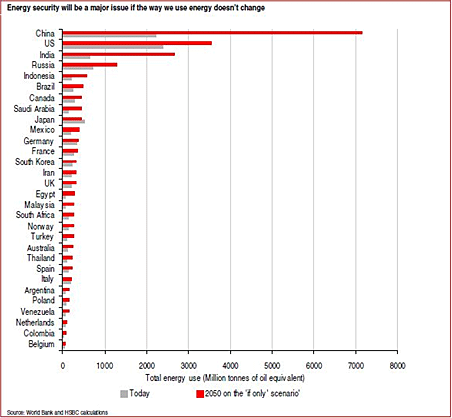
HSBC's energy outlook for 2050 forecasts that we may have as little as 49 years of oil left and we will have to radically alter our energy consuming ways to avoid a massive energy crunch.
The world may have 49 years of oil left, according to HSBC in a grim report that could serve as a wake up call for the world and its unquenchable lust for energy.
Left to its own devices, the world's demand for energy by 2050 will see a stunning rise:
* A 110% increase in oil demand to more than 190 million barrels a day to fuel the extra billion cars that are likely to be on the road as emerging world incomes increase.
* A doubling in total energy demand as emerging market growth powers ahead.
* A doubling in the amount of carbon in the atmosphere, more than three and a half times the amount recommended to keep temperatures at a safe level.
But HSBC analysts Karen Ward, Zoe Knight, Nick Robins, Paul Spedding and Charanjit Singh note that these excessive demands on existing energy can not be met - let alone our current energy appetite, unless we change the way we use the various energy sources at our disposal.
"Even if demand doesn't increase, there could be as little as 49 years of oil left. Gas is less of a constraint, but transporting it and using it to meet transport demand is a major issue. Coal is the most abundant with 176 years left, but this is the worst carbon culprit," notes HSBC in its 'Energy In 2050' report.
It's emerging markets such as China and India that will dictate demand for energy and they are the ones that will need to change their energy consumption ways.
The report cites that China will have 350 cars per one thousand people by 2050 compared to 22 today. Similarly, India will have 200 cars per one thousand people, compared to 50 currently. The trend is similar across other emerging markets as their citizens gain more purchasing power.
HSBC estimates that there will be one billion cars more cars - 1.7 billion in total - by 2050, placing excessive pressure on dwindling oil supplies.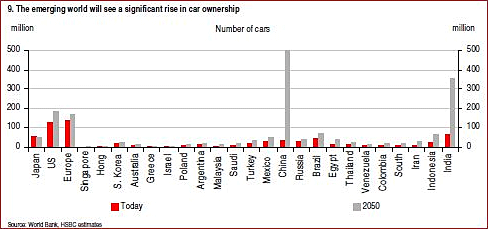
HSBC picks transportation for good reason:
* 93% of transportation sector depends on oil
* Car passengers consume 53% of all energy consumed by transportation sector
* Other key sectors such as buildings and agriculture make better use of other energy sources, with oil making up only 16.5% of their overall energy consumption
* Industries do slightly better as oil makes up 16% of their energy consumption and they depend more on coal (42%) and gas (26%).
HSBC argues that building more efficient cars is one easy solution to our problems. While that trend is slowly taking hold, it is still easier said than done.
To our mind this is the most important chart in the report and is a telling example that we are - and will remain - in an era of high oil prices: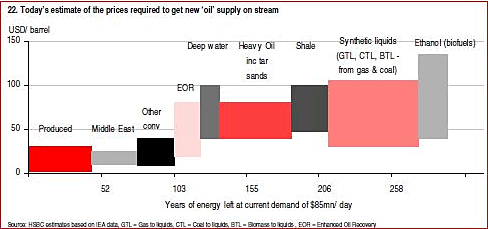
"The economic cost of satisfying the next couple of decades with oil are low, much lower than today's oil price. As we get beyond this oil is harder to reach and the cost of extraction is greater. At more than USD100 dollars per barrel, substitutes for crude such as tar sands and synthetic liquids become more viable. Towards USD150/barrel, biofuels come into their own."
But OPEC plays a tantalising game of making oil just about affordable and supply just about enough to make other energy sources expensive.
"Opec tries to manage oil prices to maximise revenue while at the same time keeping prices below the level that might encourage investment in long-term, unconventional supplies of liquid fuels (such as tar sands and biofuels) or promote efficiency improvements," HSBC notes. "After all, some members have many years of reserves left and need to ensure that oil has a long-term role in the energy equation."
Other key issue that are leading to slow growth among energy sources:
Oil: Dwindling resource, perhaps only 49 years of it left. New discoveries are harder to find and are smaller in size. Makes up 21% of global energy consumption.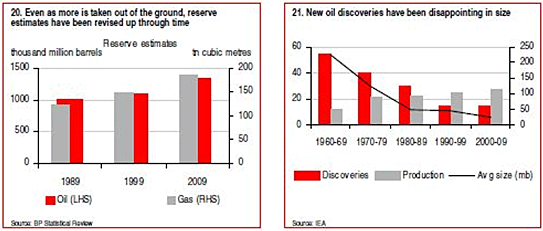
Gas: more abundant, but faces logistical and transportation challenges. In addition much of the gas is in politically troubled Middle East and, for Europe, in Russia which clearly has an agenda to leverage its energy clout for political gains. Makes up 21% of global energy consumption.
Nuclear: Japan's current nuclear crisis has made other countries take a second look at their nuclear strategy. It would not come as a surprise that nuclear energy development will be pushed back by a decade or two before it is seen as a mainstream energy source. Makes up 6% of global energy consumption.
Biofuels: A big culprit of 2008's rising food prices as corn, grains, sugar, beets and oil seeds were being diverted to make energy. The new generation of biofuels being used by agriculture product wastes (such as husks of the corn, rather than the corn itself) are promising, but currently remain an expensive technology. Make up 10% of global energy consumption.
Wind & Solar: Both are promising technology and have many supporters in Europe, China and the United States. Solar requires substantial government incentives to drive deployment. But prices are steadily falling. Make up 3% along with hydro and other renewables.
Coal: Is cheap and abundant. But it is also the worst carbon emission culprit. Makes up 28% of global energy consumption.
For the world to remain sustainable, HSBC recommends that we turn the energy mix on its head. See chart: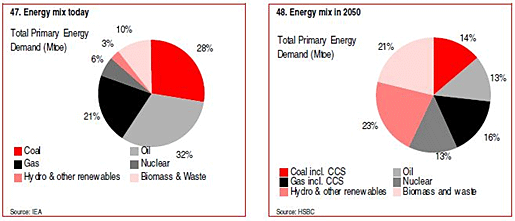
A tall order riddled with political, economic, technologically and social obstacles. But one thing is certain, all the fundamentals suggest that we remain in an era of back-breaking high energy prices and our alternatives remain under-developed. And that gives the Middle East's oil-producing states the breathing space to diversify their economies when oil does, finally, run out - may be not in 49 years, but at some point in the future.
A recent Wikileak cables notes that Saudi Arabia - the country with the world's largest oil reserves - may have overestimated its oil reserves by nearly 40%. While this has been denied by Saudi authorities, in the absence of accurate records, the U.S. Riyadh embassy cable is an interesting point to note.
The cable reads:
"On November 20, 2007, CG and Econoff met with Dr. Sadad al-Husseini, former Executive Vice President for Exploration and Production at Saudi Aramco. Al-Husseini, who maintains close ties to Aramco executives, believes that the Saudi oil company has oversold its ability to increase production and will be unable to reach the stated goal of 12.5 million b/d of sustainable capacity by 2009..."
Read the full cable here:
http://alifarabia.com/2011/04/02/wikileak-cable-that-quotes-ex-aramco-executive-saying-saudis-overstate-oil-reserves/
Whichever way you look at it, HSBC's report strikes a sombre, doomsday note and one that energy producers and consumers would do well to pay close attention to.
© AlifArabia 2011