In the second part of the 2012 regional economic prospects, we look at oil-consuming countries' quest to find peace and security after the Arab Spring, and the economic, political and social challenges that lie ahead.
Also Read Part 1: Oil Economies 2012
In the first part of the report, we looked at how oil-rich countries' are expected to manage their citizens' expectations, economic slowdown and regional and domestic political upheavals in the New Year.
The second part looks at how oil-importing MENA countries are expected to fare in 2012.
Even as there plans were upset in 2011, MENA oil exporters had a steady revenue stream flowing into their coffers, but the oil-consuming countries in the Middle East had no such luxury.
Egypt, Tunisia and Syria faced severe economic slowdown, while Jordan and Lebanon got bogged down by regional conflict, especially in Syria. Only Morocco managed to keep political dissent at bay and keep its head above water.
Still, as a whole the economies of the oil importing countries will contract by 0.4% in 2011, according to an Institute of International Finance (IIF) forecast.
"Tourism, FDI, and local private investment has been hard-hit in the first eight months of this year. The prospects in 2012 remain challenging, although some recovery in growth from a lower base is foreseen," says the IIF.
"Assuming a peaceful political transition and baseline projections of external financial support, we now expect real GDP to recover to 2.3% in 2012, underpinned by a modest recovery in investment. Oil importers will continue to face limited fiscal room and rising borrowing costs. The combined gross external financing need for Egypt, Jordan, Morocco and Tunisia is projected at about USD35 billion for 2011 and 2012."
But these grim economic statistics should be tempered with good news as well. Some of these countries have started on their journey to democracy with elections in Tunisia, Morocco and Egypt. True they have been messy, and in the case of Egypt bloody, but it has at least highlighted that transition, no matter how volatile and costly, has been initiated in those countries.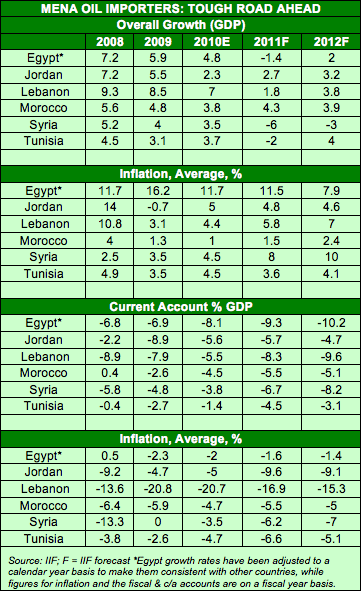
EGYPT: POLITICAL UNCERTANITY, ECONOMIC SLOWDOWN
Easily the largest and most important oil importing economy in the region, Egypt is expected to face unprecedented challenges in the New Year. Much will depend on how the staggered elections pan out and the recent eruption of violence in the second phase of the election shows how uneven and violent change can be.
First will be the completion of the parliamentary elections, which is likely to see Muslim Brotherhood's Freedom and Justice Party and the Salafist Nour party emerge as the top two parties, with the liberal Egyptian Bloc Party a distant third.
This could lead to a showdown with the Supreme Council of Armed Forces (SCAF), which has been running the country and has said it will continue to participate in politics till the presidential elections in mid 2012.
It is conceivable that the Muslim Brotherhood will assert itself more strongly against SCAF in the political arena. A Muslim Brotherhood and SCAF showdown is one of the greatest fears among Egyptians, especially once its flexes its political muscle in parliament.
However, it is not an inevitability that Egypt's foremost Islamic party remains at loggerheads with the army. Muslim Brotherhood was notably absent during the November protests against SCAF.
"In a similar vein, the Muslim Brotherhood and other Islamic political groups voted to support constitutional amendments put forward by SCAF in March 2011 to set a timeline for political reform," says risk consultancy Maplecroft.
Read full article on Egypt's Challenges: Post-election challenges
The economy has suffered due to the political paralysis.
Mahmud Nasr, a member of SCAF, said recently that the budget deficit will hit 10.8% of GDP in FY11/12 compared to an earlier budgeted figure of 8.6%.
"Though we expect FY11/12 to see an increase in aggregate revenues, backed by non-tax revenues; higher interest payment and wages and salaries will further widen the deficit. We expect a deficit to GDP of 11.3%," says Cairo-based CI Capital Research.
Ratings agencies Standard & Poor's and Moody's have consistently been downgrading Egyptian prospects.
"Egypt's external payments position continues to deteriorate in the post-revolution era," said Moody's in a recent report.
"Foreign-exchange reserves have fallen 44% since December 2010. At USD20.2-billion, reserves are still adequate for policy purposes or to cover near-term debt repayment, but the depletion has accelerated since the government turned down International Monetary Fund support in June."
The economic downturn in Europe is compounding pressure on Egypt's balance of payments from domestic political turmoil. Receipts from tourism, exports and the Suez Canal are faltering too, adding to the woes.
"Moreover, foreign direct investment in Egypt has suffered a striking reversal, to a USD65 million outflow in the first half of this year from a USD4.2 billion inflow in the first half of 2010. In the absence of further financial support, the Central Bank of Egypt (CBE) will find it increasingly difficult to maintain adequate international liquidity," says Moody's.
Egypt is in reportedly in talks with the IMF for loans, after spurning the Fund earlier in the year. Qatar, Saudi, UAE and Kuwait have already pledged to invest in the country, but with the economic environment deteriorating the funds may be slower to come forth than earlier expected.
"The victory of Islamists may bring about more Gulf-based financing in the period ahead. Continuing and accelerating discussions with the IMF would also be necessary to mobilise other international donors," says a Barclays note.
The Egyptian Stock Exchange has fallen 47% this year and is the worst performing mainstream indices in the region. Investor confidence will be important to bring funds back into the country, but unfortunately, politics will take precedence over economic concerns.
"The absence of foreign investor participation in local debt markets, as well as delays in disbursement of pledged external financial support, have concentrated newly issued debt in the hands of local banks," says Barclays.
The latter became increasingly nervous about the uncertain outlook for the Egyptian pound amidst political turmoil. In parallel to yields trending steadily upward, the sizes of the auctions have increased significantly, beyond what is required to roll over maturing debt, reflecting widening deficits and increasing intensity of a negative debt dynamic loop.
The IIF expects the Egyptian economy to contract 1.4% this year and rebound to an anaemic 2.0% growth in 2012.
And as foreign exchange reserves hit record lows, Egypt's fragile external position remains a top concern, as does its increasingly vulnerable fiscal situation, says Alia Moubayed, an analyst at Barclays.
"Although the Central Bank of Egypt has some tools to support the pound, including hiking interest rates and encouraging repatriation of banks' net foreign assets (NFA), these tools are not without their limitations."
TUNISIA: AN IMPRESSIVE TURNAROUND
Tunisia is where it all started. The sacrifice made by the street vendor Mohamed Bouazizi who set himself on fire and epitomised the collective rage of the Arab citizenry against its rulers, has changed the course of Middle East history.
The year was tough for Tunisia but not without its rewards. The economy sputtered and there were a few false starts after Tunisian dictator Zine El Abidine Ben Ali fled, but eventually the Tunisians got it right.
A free and fair election was the reward for Tunisians' hard toil and they chose to elect Ennahada, a religious party, into power, which should be respected by the international community.
Barclays Capital notes that a daunting economic agenda awaits the government, particularly given the uncertain economic outlook in the euro area and the MENA region as a whole. In the short term, the imperatives of creating jobs, promoting a more inclusive economic growth model and expanding safety nets are likely to be constrained by the need to maintain fiscal discipline amid greater uncertainty in financial markets.
"In Tunisia, where the political transition is consolidating following the elections, growth is gathering momentum," says Barclays.
With Q2 11 real GDP growth registering -0.5% year-on-year, import growth has rebounded since July and intensified further in October (16%) compared with almost zero in January and March, and -4.4% in July, highlighting accelerated domestic demand.
"Moreover, industrial production halted its contracting trend in August, having shrunk by 4.5% year-on-year in July. Nevertheless, a weakening euro area outlook is likely to constrain a rapid rebound in growth and undermine a swift recovery in Tunisia, we think," says Barclays.
MOROCCO: PEACEFUL TRANSITION, BUT REAL REFORMS?
Opinion is divided whether Morocco's recent election ushered in a new chapter in its history, or it has been a clever ruse by the authorities to maintain the status quo after protests rocked the country earlier in the year.
Still, another Islamist party - the Justice and Development Party (JDP) - is going to form a new government, as Morocco moves towards a constitutional monarchy.
Like Tunisia, Morocco has suffered due to the sovereign debt issues in EU, and that's likely to continue in the New Year.
Real GDP growth in 2011 is projected at 4.3%, driven by a rebound in agricultural output, predicts the IIF.
"Non-agricultural growth is expected to decelerate from 4.7% in 2010 to 3.5% in 2011, partly due to weaker investment and demand from the euro area. A good agricultural year, subsidies on food and petroleum products, and a stable exchange rate helped to maintain a low y/y inflation rate of 1.8% in July 2011."
And while the elections has gone a long way in diffusing tension, they will need to be supplemented by deep structural reforms in the economic sphere to help Morocco grow by at least 6% a year if it is to reduce unemployment and poverty. This would require the implementation of economic reforms and the maintenance of macroeconomic stability.
Morocco, along with Jordan, has shown its interest in joining the Gulf Cooperation Council. Not much progress has been made on the issue since the announcement came in early 2011, but access of Moroccan businesses to the oil-rich states could certainly boost economic sentiment in 2012.
SYRIA: GROUND-ZERO OF ARAB SPRING 2012
While Syria may be a small economy, it wields tremendous political influence in the Levant and as a key Iranian ally.
The country has been embroiled in a bloody conflict with its citizens who are demanding greater economic, social and political reforms. Despite the Syrian regime killing more than 4,000 of its people, dissent has continued. Things have turned even grimmer after many soldiers defected and have brought military teeth to the previously non-violent struggle by the citizens.
As such, President Bashar Al Assad's next steps could have a huge impact on the regional economic outlook.
There is fear that if the Syrian regime falls, there is no knowing how the Iranian regime and Hezbollah in Lebanon will respond. Even as some of its allies like Ankara and Riyadh have distanced themselves from President Assad, Tehran and Beirut remain steadfast and unflinching allies.
The IIF expects the Syrian economy to contract as much as 6% in 2011 and another 3% in 2012, especially as international sanctions take their toll on the economy.
"Divisions within the regime could appear if the economy continues to contract in 2012, as some key business players start to distance themselves from the regime and the capacity to finance the repression weakens," says the IIF.
Crude oil production has declined steadily from 635,000 barrels per day in 1996 to 375,000 in 2010, and Syria has been a net importer of oil since 2008, with the value of imported petroleum products exceeding the value of crude oil exports.
Foreign exchange earnings from exports of goods, tourism, FDI, and workers' remittances are projected to decline from an estimated USD20.5 billion in 2010 to USD12.0 billion in 2011.
Both the external current account and fiscal deficits are expected to widen to over 6% of GDP. Consequently, official foreign exchange reserves are expected to decline from USD19.5 billion at end-2010 to around USD15 billion by end-2011, still at a comfortable level and covering more than 12 months of projected imports of goods and services.
"As the sanctions bite further and the uprising persists in the coming months, the regime could weaken further and internal divisions could begin to erode stability. However, the situation remains complicated. In contrast to Tunisia and Egypt, the internal struggle could go on for some time without either side prevailing. We therefore expect continued turbulence into 2012 with adverse economic impact," says the IIF.
JORDAN: CAUGHT IN THE MAELSTROM
The Jordanian economy is quite sensitive to regional economic turbulence. Much of the economy depends on FDI from within the region, apart from tourism and trade and remittances from its citizens working in the Gulf.
The economic sluggishness has been primarily driven by a faltering tourism sector and a weakening investment drive both domestic as well as foreign, says Amman-based Capital Investment Research.
"Rising oil prices and the disruptions of natural gas supplies into Jordan have also added to the challenges facing the kingdom, increasing its import bill and widening the current account deficit, which along with the slowdown in FDIs, have weighed on foreign currency reserves."
The government has tried to arrest the slowdown through subsidies and tax cuts which has raised borrowing costs and reduced fiscal flexibility.
"As a result, the economy is expected to go through a rough period during the remainder of 2011 and in 2012 as economic recovery is usually a protracted process," says Capital Investment.
But there are reasons to be hopeful: Domestic exports, construction activity, real estate trading, and Aqaba port activity are up year-over-year, with remittances, inflation, and foreign reserves remaining relatively stable, and last but not least, GDP growth is still in positive territory.
"Another aspect that supports our less pessimistic view of a possible recovery in the medium term is the continued and committed support from foreign donors, mainly Saudi Arabia and the US," says the Amman-based investment bank.
To tide over the tough times, Saudi Arabia has provided Jordan with a budgetary grant of $1.4-billion, which is equivalent to 5% of GDP.
Unemployment, which stands at 13.2% remains a crucial issue, and could ignite more determined protests. Jordan did face a small number of protests in 2011, but they were largely contained by the authorities.
Like Morocco, Jordan has also been encouraged by Saudi Arabia to apply to join the Gulf Cooperation Council, and the economy could certainly get a fillip if it becomes a part of the oil-rich economic bloc.
LEBANON: TOUGH NEIGHBOURHOOD HOLDS BEIRUT BACK
Resilient Lebanon finds itself caught in the crossfire once again. With close ally Syria in trouble, Lebanon has seen its economy slow down, real estate activities decline and general tourism and trade take a back seat.
Domestically, the Lebanese government dodged a bullet by paying its share of the Special Tribunal for Lebanon (STL) budget, which prevented the government from falling.
However, the country is faced with managing an even bigger risk emanating from the escalating Syrian crisis. As downside risks to growth increase, the draft 2012 budget, as presented, could reverse past gains and exacerbate sovereign risk, says Barclays.
"Crippling sanctions on Syria could in fact seriously affect Lebanon's economy. Trade and investment linkages between the two countries, both formal and informal, have deepened significantly in recent decades. Twenty-five percent of Lebanese exports are destined to Syria, with another 10-15% transiting through Syrian territory to other countries."
As sanctions bite and violence continues, Lebanon also has to manage thousands of Syrian refugees moving across its borders. It also has to deal with increased scrutiny of its trade and financial systems to ensure compliance with international and regional sanctions, and cope with heightened security risks.
Lebanon is forecast to see its economy grow by a mere 1.8% in 2011 and 3.6% in the New Year. But the government faces tremendous pressure to increase spending.
"We have increased our 2012 fiscal deficit forecast from 8.5% to 9% of GDP. This is likely to keep government debt-to- GDP ratio at 131% of GDP, as the primary surplus is expected to shrink from 2.5% of GDP in 2011 to 1.2% of GDP in 2012 on the back of expectations of rising wages and salaries."
YEMEN
The poorest regional economy has had a terrible year as Yemeni president Ali Abdullah Saleh tried for months to hold on to power despite the pleas of his Gulf allies to relinquish control.
Saleh has finally handed over his constitutional powers to his deputy who has asked the opposition to form a government. Saleh himself will remain installed as president until elections takes place in February.
Saudi Arabia has been quick to promise the new Yemeni government aid and help in its transition, and hopefully for the Yemenis and its regional allies, it is the start of a long, but peaceful return to some kind of normalcy in the country.
© alifarabia.com 2011