We have always known it, but could never really put our finger on it. Until now.
The notion that a few shadowy powerful figures that control the fate of the global economy, interest rates and stock market fluctuations, with the power to pick winners and losers, does not seem implausible if you consider a recent study by three Swiss researchers who have examined the network of global control.
The study examines 43,060 transnational companies (TNC) across 191 countries, from a sample of 30 million economic actors - such as shareholders and subsidiaries - from a 2007 database.
"We then apply a recursive search which singles out, for the first time to our knowledge, the network of all the ownership pathways originating from and pointing to TNCs. The resulting TNC network includes 600508 nodes and 1006987 ownership ties," note Stefania Vitali, James B. Glattfelder, and Stefano Battiston, researchers based in Zurich.
The structure of the control network of transnational corporations affects global market competition and financial stability, say the authors. So far, only small national samples were studied and there was no appropriate methodology to assess control globally. We present the first investigation of the architecture of the international ownership network, along with the computation of the control held by each global player. We find that transnational corporations form a giant bow-tie structure and that a large portion of control flows to a small tightly-knit core of financial institutions.
Here are their key findings:
* In terms of connectivity, the network consists of many small connected components, but the largest one (3/4 of all nodes) contains all the top TNCs by economic value, accounting for 94.2% of the total TNC operating revenue
* The connected structure explains why there are such strong anti-takeover strategies, reduction of transaction costs, risk sharing, increasing trust and groups of interest. No matter its origin, however, it weakens market competition.
* Similar to the Internet, the TNC network has a bow-tie structure. Its peculiarity is that the strongly connected component, or core, is very small compared to the other sections of the bow-tie, and that the out-section is significantly larger than the in-section and the tubes and tendrils. The core is also very densely connected, with members having, on average, ties to 20 other members. As a result, about 3/4 of the ownership of firms in the core remains in the hands of firms of the core itself. In other words, this is a tightly-knit group of corporations that cumulatively hold the majority share of each other.
* 737 top holders accumulate 80% of the control over the value of all TNCs. In particular, the top ranked actors hold a control ten times bigger than what could be expected based on their wealth.* Nearly 4/10 of the control over the economic value of TNCs in the world is held, via a complicated web of ownership relations, by a group of 147 TNCs in the core, which has almost full control over itself. The top holders within the core can thus be thought of as an economic "super-entity" in the global network of corporations. A relevant additional fact at this point is that 3/4 of the core are financial intermediaries.
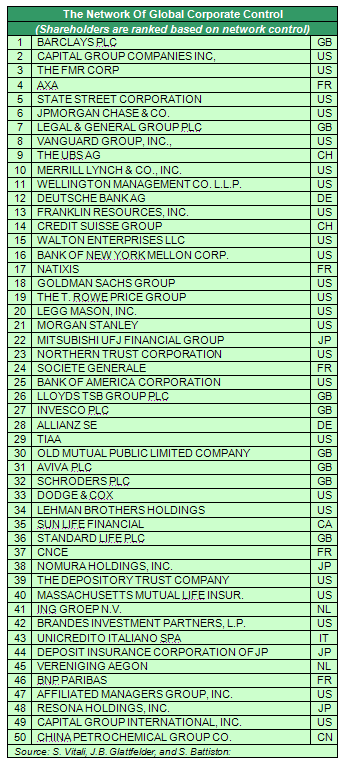
* This is where contagion comes in: Given that the same group lends to each other and invests in each other. We saw that contagion with the fall of Lehman Brothers (which is in the list of the 50 most powerful companies in the world listed below, as the researches used 2007 data when the investment bank existed).
* What are the implications for market competition? Since many TNCs in the core have overlapping domains of activity, the fact that they are connected by ownership relations could facilitate the formation of blocs, which would hamper market competition.
* Results show that, globally, top holders are at least in the position to exert considerable control, either formally (e.g., voting in shareholder and board meetings) or via informal negotiations.
* "A bowtie structure with a very small and influential core is a new observation in the study of complex networks. We conjecture that it may be present in other types of networks where "rich-get-richer" mechanisms are at work. However, the fact that the core is so densely connected could be seen as a generalization of the "rich-club phenomenon" with control in the role of degree."
* Difference between 'control' and ownership: While ownership is an objective quantity given by the percentage of shares owned in a company, control, reflected in voting rights, can only be estimated using a model. There are two steps involved in the derivation of the notion of control we use in this work. Firstly, direct control is estimated from the direct ownership relations. Network control is then computed on the basis of direct control considering all paths in the network.
* Why do financial services companies dominate the list?: A sector analysis of the LCC shows that the most represented industries are the business activities sector, with 130587 companies, followed by the services sector with 99839 companies and the manufacturing sector with 66212 companies. On the other hand, surprisingly, the financial intermediaries sector counts only 46632 companies. However, if we distinguish between in-going and out-going relations, the financial intermediaries hold the largest number of shares (341363). Instead, the manufacturing and services sectors, with respectively 182699 and 170397 companies, have the companies with the most shareholders.
The researchers argue that the financial services exert control in many ways, not just through direct ownership of a company, but also because they happen to own shares of other entities linked to that company.
"In the literature on corporate control there is a debate on weather financial institutions really exert the control associated with their ownership shares. On the one hand, they are not supposed to seek an active involvement in the companies' strategies," note the authors. "However, some works argue that institutional investors, including banks and mutual funds, do exert control to some extent. In particular, the outcome of votes can be influenced by means of informal discussions, in which pro-management votes are used as a bargaining chip (e.g., in exchange of business related 'favors' or in negotiating the extension of credit).
* Still it must be said that there are a few custodian banks, which do not have any control whatsoever, even in an indirect manner. Perhaps they should have been eliminated from the list.
© alifarabia.com 2011